October 13 2025
Frost
Frost is one of those things that centralizes the focus of most vegetable growers and orchardists. We discuss and plan for the first frost-free date each spring, and sometimes hedge our bets on when we can start planting. And by the end of the season, there is a mix of emotions, from wishing the frost would come and start the winding down process, to wishing for a few more days or weeks so that those late planted crops can have a good chance to make it, or the long termers can eke out a few more pounds of wonderfulness. Over the past 44 seasons we have seen the first frost come as early as August 23 and as late as mid-November, with everything in between. I used to say that you could expect that the first frost would come by October 8, and indeed this year it hit on October 10. Does that mean we are experiencing some kind of average this year?
Over the years I have observed myself with respect to the frost and remember that for the most part for me it was a nail-biting time of fear that I would not have enough food for the CSA if it came too early, and often finding myself caught unawares and out either harvesting or putting down Reemay at all hours of the night. But with the passage of time, I have come to recognize that frost will come, crops will end, and life will move on to the next beautiful phase. I felt ready for this frost, put the amount of pre-prep into it that I thought was appropriate (though I probably would have harvested Friday’s tulsi, if I had thought things out further). With Marissa’s loan of the neversink hoops (explained below), I can see how next year we could hoop and cover more crops more easily than with our present system of Reemay and black sand bags. Frost time is a passage time, and I feel excited about the cold months ahead.
We have old layers for sale
$20 each, fresh (in the bag) on Sunday, October 26, 20 birds available – great soup! Email me at julie@mhof.net to reserve.
We are looking for a male non-neutered puppy, either a hound dog cross or a shepherd cross. Skippy and Harriet are looking for a future mate and we are looking for a young guy who likes to chase carnivore predators. Does anyone have any leads?
We are also looking for two kittens, also non-neutered, to bring these wonderful animals back into our family. If you know of any, please let us know.
Gratitude this week
For those of you who are lucky enough to have children, you know how different each one is. We might note through their lives that so and so has uncle’s eyes, or grandma’s temper, or brother’s intelligence. The list goes on and on. One time someone did our astrological charts for our family of 6 and noted that we had 5 type A’s and 1 type B. That would be Paul, who happens to be 47 today. In our family it manifested as him never having much preference when a decision as to this or that was on the table. He always was up for whatever the greater good was. Paul is nobody’s fool, but he is often liked because he can accommodate others while getting his needs met. Smart as a whip too, he was an unchallenged spelling bee champ as a kid and later helped the teacher teach calculus in high school. I feel very lucky to be related to Paul, who continues to be a joy to all those who come into his company.

Shawnee, Geoff and Paul at Clare’s farewell party in 2024
2025 MHOF CSA
Farm Share on October 10

Notice the farm car styling in the background with its new hatch!
Week of October 13 – this is the third to last week of the summer CSA
This week you can expect the following
CSA
- Peppers on Monday (W and F got peppers last week)
- Lettuce
- Asian

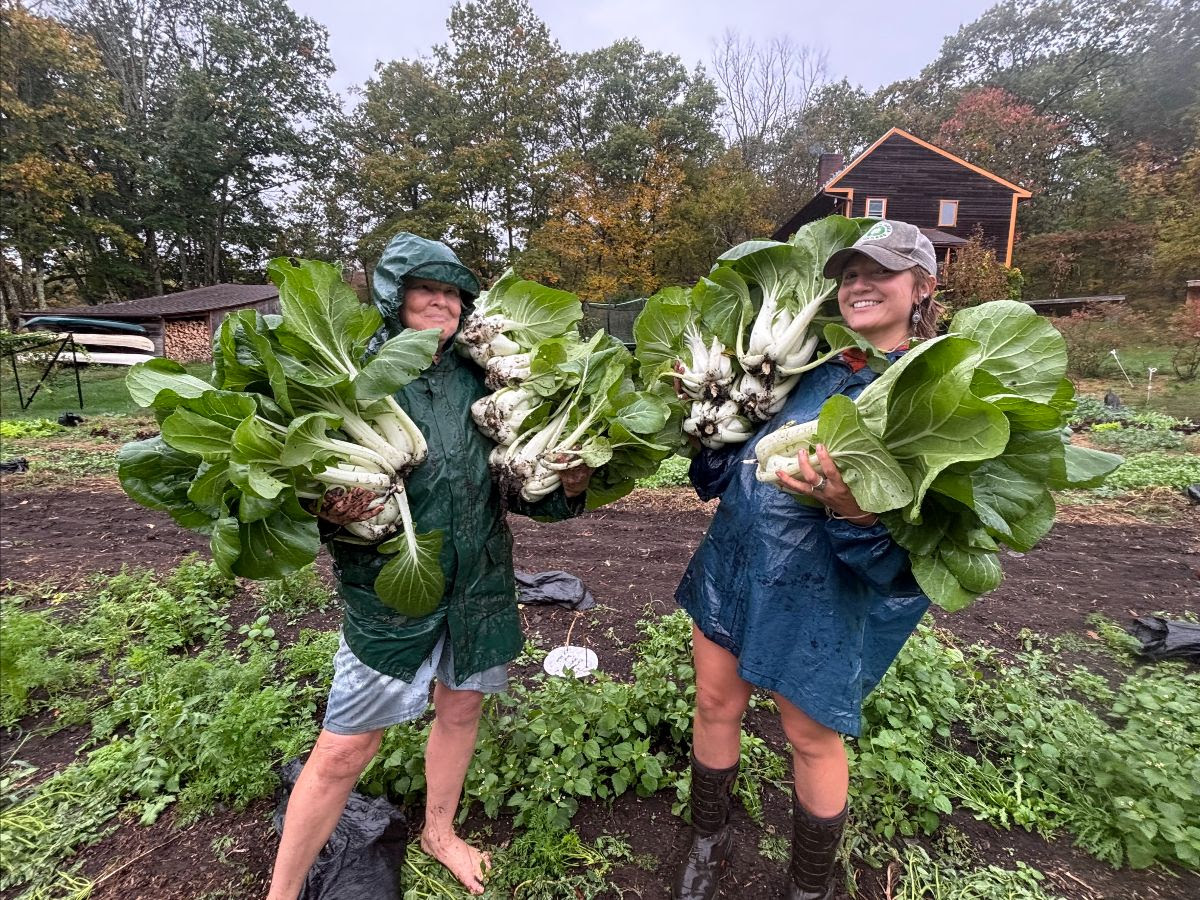
Yes, that is bok choi
- Cilantro
- Arugula
- Collards
- Celery
- Turnip greens
- Carrots
- Beets
- Leeks
- Tomatoes

You will be getting your tomatoes from the basement floor until they run out
Sign up for the fall share now
We signed up 5 folks for the fall share this past week, and still have room for more subscribers. Keep the good food times going!
Plastics – Our Generation’s Problem?
Jack Kittredge
Besides the normal, uneventful realities of plastic in my life – you know, the “paper or plastic?” question we get at the store or deciding how to get rid of a party’s worth of trash that shouldn’t be burned or landfilled, but is far too complex to source by recycle type – I had two thought-provoking experiences about plastic in my life. One was my father, an engineer, while I was probably 8 or 10, bringing home a block of a hard material about the size of a wallet and telling me it was Bakelite or ‘plastic’ – a man-made material he had never seen before which could be fashioned, colored and shaped into anything. It must have been in the early 1950s. The other was the report by my son Charlie that when he went for a sail in the Caribbean in college in the early 2000s the ship encountered a huge miles-long ocean-current-collected mass of floating plastic bottles and trash. In a short 50 years this material had become so ubiquitous that it was now a global waste problem.
Plastic is a term for anything molded under heat and pressure, but modern ones are chains of molecules created by chemists from synthetic materials, largely derived from petroleum. After World War II they began to replace more natural materials like wood, glass, paper, animal shell, rubber, ivory and metal. Making them is cheap and easy, which is why the amount produced has risen from 2 million tons in 1950 to 475 million tons in 2022. An industry featuring names like DuPont, Dow, Exxon/Mobil, and BASF arose, finding ways to use waste from processing crude oil and natural gas to make such materials as polyethylene, nylon, Teflon, polystyrene and polyesters. The most popular plastic in use is the polyester bottle, designed for pressurized drinks but widely used for water as well. Some 500 billion of these single-use containers are sold each year.
The scale of the industry is resulting not just in massive trash islands in the ocean. Since fossil fuels are crucial to plastic production, it has a huge impact on climate change, contributing to global CO2 levels. Tiny pieces called microplastics have been found widespread in nature – including throughout human bodies. Their full effect is not known, but scientists believe hundreds of thousands of people worldwide are affected. The impacts include impaired reproductive potential, diminished cognitive function, hypertension, obesity, diabetes, stroke, heart disease and cancer.
We use plastics on the farm, like most businesses today — although we try not to employ them for single uses. We are a favorite site for customers to recycle – fiber egg cartons, empty yogurt quarts, plastic bags, rubber bands. If you get them from us to separate your food they are being reused already. So please continue their multi-use purpose. Collect and return them to us periodically and we will use them again.
But we all need to do a better job with plastic. The key is moving away from single use altogether. Recent talks in Geneva hoped to do just that, but deep divisions emerged between the 184 nations at the Intergovernmental Negotiating Committee in August and the talks collapsed. One side of over 100 countries wanted binding caps on plastic production and the elimination of harmful chemical use. Oil-producing countries (including the US, Russia, and Saudi Arabia) wanted only better waste management and recycling, but opposed binding production limits.
As with so many issues, we can do better and need to start that process at home.
Jennifer’s Recipe of the Week
For those of you who received fennel last week,
Cardamom-Kissed Butternut & Fennel Soup
This Cardamom-Kissed Butternut & Fennel Soup is pure nourishment for body, mind, and spirit — a golden elixir of balance and comfort. In Ayurveda, butternut squash offers grounding sweetness that soothes Vata’s restlessness and replenishes depleted ojas, while fennel cools and calms Pitta, aiding digestion and easing the nervous system. The gentle warmth of cardamom awakens agni — our digestive fire — helping the body assimilate the nutrients with ease. From a Western lens, these same ingredients deliver a symphony of nourishment: beta-carotene and vitamin C from the squash to support immune strength, anti-inflammatory compounds from fennel to calm the gut, and mineral-rich bone broth to restore the body on a cellular level. A swirl of homemade raw milk yogurt brings probiotics for gut health and a cooling, creamy balance that mirrors Ayurveda’s emphasis on harmony between warmth and moisture. Together, these elements create a bowl that comforts the senses, steadies the mind, and nourishes the whole being — a beautiful reflection of how ancient wisdom and modern nutrition meet at the same table.

Farm Doins
Following on that week where everything was looking stupendous, we experienced our first hard frost – a “warm up” on Wednesday night that hit the house side of the road, and then the real thing on Thursday night (October 10 for the frost record) which did in all the fainter of heart friends – tomatoes, peppers, tulsi, galinsoga (yes, that is a weed), marjoram, summer squash, summer savory. Additionally, the kale, collards and broccoli were a bit burned, and the chard also was a bit burnished. But surprisingly the Asian greens – mustard, tatsoi, bok choi – seemed unfazed, and the frost rolled off the shoulders of the young spinach, the lettuce, the cilantro and the parsley, leeks, turnip greens, arugula, celery and celeriac. It is fascinating to watch these plants and wonder about their relative frost sensitivities. Anyway, there is no frost in the immediate forecast, so we will see how these more stalwart veggies hold up over the next couple of weeks. Needless to say, a lot of our time was spent readying for frost and covering some things with Reemay (a brand of polyester row cover). For a bed of chard Marissa graciously loaned us some Neversink LowCatTM hoops.

Watch on Instagram
Watch on Facebook
On Monday Danny, Stu and eventually Justin finished up the repairs for the Clare house. Just in time to plant it with greens for the winter.


Tuesday, we made our last hay

Watch on Instagram
Watch on Facebook
On Wednesday and Friday we planted our two hoop houses (we have loaned the orange house to Marissa and Drew, with lettuce, Asians, chard, kale and collards. Some of these crops might show up in the fall share, and some might still be around for winter sales and then the beginning of the 2026 summer share. It was a good accomplishment to take the Clare and the blue from cucumbers and tomatoes on trellises back to winter crops. And then on Saturday, Sophie, back from MHOF maternity leave (sadly she did not bring little JJ for us to ‘ooh’ and ‘aah’ over), Holly, Shantel and Alexandria and I planted 1 ½ beds of lettuce in the garden. Next week we will cover them with Reemay and see if we get a crop from them.
On Thursday, the tree crew came by and took down two ash trees that were on the town’s side of the stone wall on the road. The heartbreak for us was that they took down the tree from whose branches we had hung our rope swing. Many, many children over many decades enjoyed that swing. Alas.

And on Saturday, Brandon, Justin, and John got most of the wood moved onto the end of our driveway for prepping to fill our woodsheds. And the tree guys delivered us a load of chips that will be used for mulch on the farm.
Also on Thursday, Leigh Mae from American Farmland Trust stopped by to advise us on some farm improvement projects. What a wonderfully intelligent, knowledgeable and helpful person.
Julie