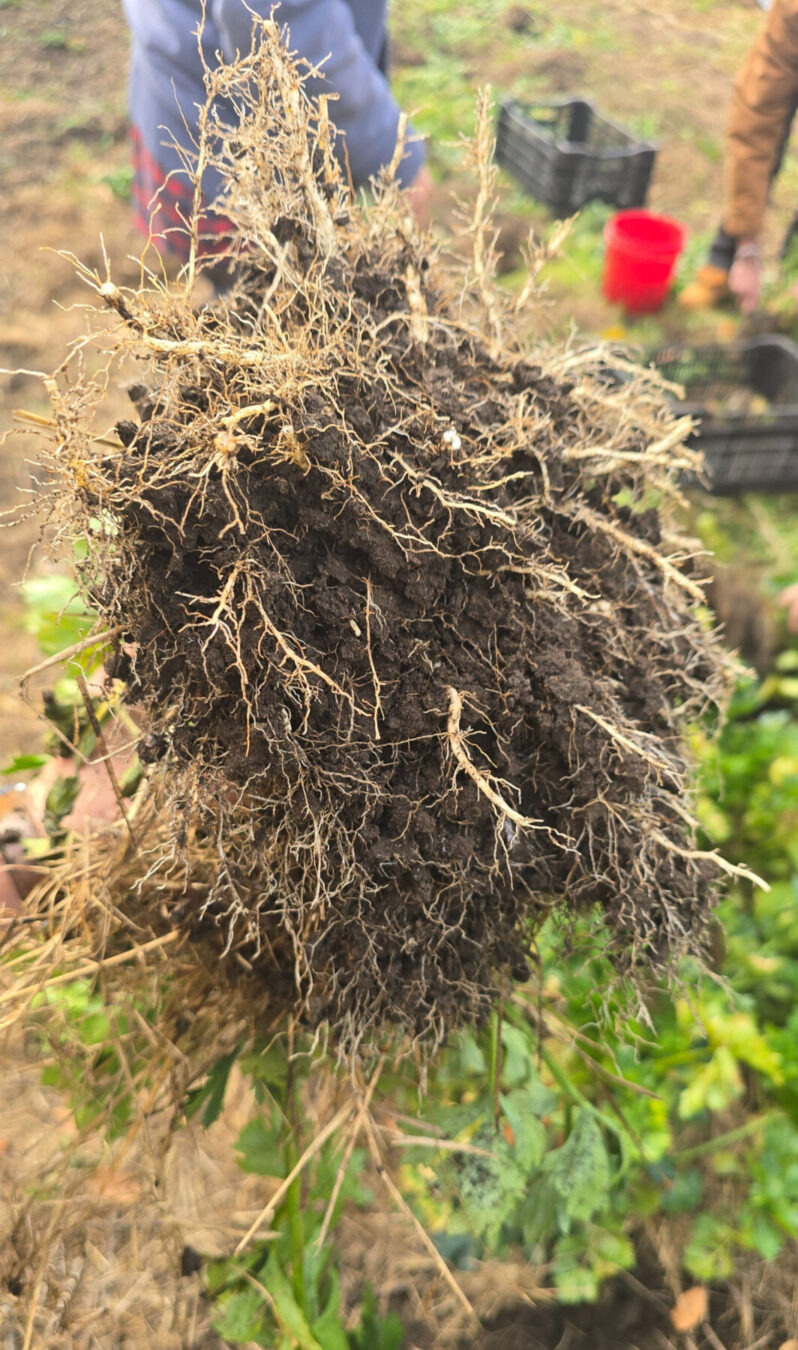
Soil aggregates on celeriac roots

Celeriac

Who knows what celeriac is? Perhaps you have heard of celery root? It may be one of the homeliest of all vegetables – a lumpy root vegetable with celery growing on top of it (though the celery is not of high quality). I am featuring it this week because it is so homely, it is very poorly known, and because it is one of the best carbon sequesterers in our gardens. When one pulls it out of the soil, it brings with it a prodigious mass of roots and soil.

When you boil it up with other roots in a soup, it is an amazing thickener that imparts the slightest celery flavor to things. From our bodies’ standpoint, it contains a lot of vitamin C and B vitamins, and also potassium, calcium, magnesium and iron.

Here is a very accessible article that discusses preparation – https://www.marthastewart.com/celeriac-celery-root-8597968. I don’t peel it, but do take a stiff vegetable brush to it, as it loves to hold onto the soil. As we start to really enter the root soup season around here, I am very enthusiastic about adding celeriac in with the usual beets, carrots, and potatoes. More flavor, more energy, more diversity in the diet for the gut biome.

We are back selling eggs again
At $9/dozen – perhaps the world’s best tasting eggs, who eat certified organic feed and who have fresh pasture 5 days out of 7, from our super healthy and diverse pond field pasture/hayfield.

We are looking for a male non-neutered puppy, either a hound dog cross or a shepherd cross. Skippy and Harriet are looking for a future mate and we are looking for a young guy who likes to chase carnivore predators. Does anyone have any leads?

We are also looking for two kittens, also non-neutered, to bring these wonderful animals back into our family. If you know of any, please let us know.

Gratitude this week

This week my highest appreciation goes to Marissa Gabriel, who has worked here now almost 3 seasons on the farm. She and her partner Drew have also finished one season of using the pond garden for their own farming venture, and are paying the “rent” by spraying our fields and fruit each week with our nutritional sprays. We provide water, access to the washing table and part of the walk-in, and they do chores for us sometimes when we go away. A couple of months ago we turned over the orange hoop house to them. Last week Marissa and I conversed about how we could be of more support for each other, discussing joint marketing ventures among other possibilities. I am grateful that we are developing this relationship with Marissa and Drew

A couple of weeks ago I did a video of Marissa loaning us a test bed’s worth of hoops from Neversink, to be used for holding reemay, or plastic or shade cloth. We had a very successful trial using this new system to hold our reemay up off of a chard bed. The chard fared beautifully in the surprisingly damaging October 10 frost. As we were preparing for our next set of hard frosts — which came Friday night and will happen Saturday and Sunday nights before publication — using our old system of reemay laid on top of beds and held down by back sand bags, Marissa offered us a bunch of the Neversink hoops and bungie cords. https://neversinktools.com/collections/lowcat-low-tunnel.

We spent a couple of hours on Saturday learning how to use the low cat tunnel system and were able to successfully cover our Brussels sprouts, kale, collards, some cabbage and leeks.

Thank you, Marissa, for supporting us in this way. I will sleep easier for the next 5 weeks of the CSA (one more week of the summer share and 4 weeks of the fall share) with these tunnels in place. Now that I can see how valuable this system is, it will open up tremendous possibilities for us for early and late season production in the field, and also hoophouse production over the winter. It is wonderful when farmers can support each other.

2025 MHOF CSA

Please bring your share bags back to your delivery site this week. We will launder them and use them again next year! 

The summer CSA is over this week! After 22 weeks of worrying over feeding all of you – about 140 shares — we can ease into our last week knowing that we worked assiduously to provide you the best food we can produce. It was one of the most difficult years we have experienced in the past several, way too cold and rainy through May and then too hot and a drought through September, with ensuing predation. I am relieved that it is over, yet am excited about everything I learned or relearned about proper irrigation, proper locating of our crops with all of the considerations of shade, cold pockets, low land, high land, wild animals and water tables. I am ready to incorporate the lessons of 2025 to our planning for 2026!

The last week of the MHOF Summer CSA will include

  • Lettuce

  • Asian green

  • Cilantro

  • Arugula

  • Kale

  • Collards

  • Broccoli, cabbage or cauliflower

  • Delicata squash

  • Turnip, radish or rutabaga greens

  • Swiss chard

Last chance to sign up for the fall Share – we are closing it on Friday

Here is what we will have – leeks, collards, kale, beets, potatoes, winter squash, lettuce, Asian greens, celery and/or celeriac, parsley, carrots, radishes, arugula and lots of beautiful spinach.

Order yours today

A Notable Bicentennial

by Jack Kittredge

A Washington Post article last week by George Will noted the 200th birthday yesterday of the Erie Canal. That waterway was a wonder of its time and had a major influence on shaping Massachusetts agriculture. It is a fascinating story.

A highly sophisticated engineering project (the longest previous US canal was only one-thirteenth as long) the canal included 18 aqueducts and 83 locks for managing 675 feet of changes in water elevation. It was dug before power equipment was imagined, by human labor only, to a width of 40 feet and depth of 4 feet. Begun in 1817 and financed entirely by the state of New York, the project took 8 years and came in ahead of schedule and significantly under budget! A generation before railroads, the 363-mile canal transformed early commerce by traversing New York from Lake Erie to the Hudson River, enabling cargo from the Midwest to travel by boat, via the Great Lakes, from Minnesota to New York City.

Boat travel meant cargo could be loaded once, at the beginning of the journey, and then unloaded once, at the end. It also meant that the horsepower needed to pull a 2-ton load in a cart or wagon could now pull a 50-ton load when in a canalboat. Once built, the cost of shipping a ton of cargo from Buffalo to New York City dropped by over 90%. These striking increases in shipping efficiency had several remarkable results.

Midwestern farms began outcompeting those in New England. Their productive soil yielded far more than rocky New England could. Once their goods were here, prices dropped so much that our farmers could not contend with them on most products; we had to specialize (tobacco, dairy) to stay in business. By 1830 many Eastern farmers had simply abandoned their land (no one would buy it) and moved west. Others took up trades (blacksmithing, woodworking, coopering) and farmed on the side. Some still do that!

Other transit infrastructure was spurred. Projects like the Blackstone Canal (authorized to run from Worcester to Providence in 1823) and the Western Railroad (connecting Boston and Albany in 1841) were undertaken, as well as many smaller canals and railroads linking cities and towns in New England, to recreate the miracles of transport economics that were unfolding in New York.

Urbanization and industrialization increased. Many Massachusetts farmers who found it no longer possible to support themselves on the land moved to work at the new textile mills and factories (in places like Waltham, Lowell, and Holyoke) which were being created using water power from New England’s many rivers and streams. New York City became the country’s dominant commercial and financial center, winning its age-old rivalry with Boston.

When our kids were young and Julie and I were traveling we would sometimes stop for an hour or two and visit some of the locks still maintained at old canal sites along the Mohawk and Hudson Rivers. I could see the kids pointing, studying and understanding these simple and elegant systems using natural forces to raise and lower boats over rises and dips in the land. I loved that they were seeing how humans have solved such problems without using powered machines, just their imaginations.

Jennifer’s Recipe

Speaking of arugula – This made a delicious breakfast this morning

Roasted Celeriac, Carrot & Beet Over Arugula
This nourishing bowl captures the heart of Vata season — grounding, aromatic, and full of life force. The trio of celeriac, carrots, and beets anchors airy Vata with their earthy sweetness and ojas-building qualities. Roasting them in ghee with cardamom, cinnamon, and fennel awakens gentle digestive fire (agni) and soothes the nervous system.

* Cardamom adds lightness to heavy foods and uplifts the mind.
* Cinnamon warms circulation and brings comfort.
* Fennel aids digestion and subtly cools, balancing the warmth of the other spices.

The addition of avocado and tahini brings the unctuous, oily quality that Vata craves, while the lime and arugula prevent sluggishness with a touch of brightness and bitter balance.

Perfect for a grounding breakfast or lunch, this bowl harmonizes body and mind — warm, sweet, oily, and alive with subtle spice. A delicious reminder that nourishment can also be joy.

Get the recipe now

Farm Doins

Monday was pretty wet and pretty cold, so after we finished the CSA everyone came in to split garlic for fall planting.

On Tuesday, Justin, Marissa and I made up three beds for garlic planting, weeded out the edge of the orange house and also weeded the asparagus patch – a worthy day’s work. We also organized the barn and cleaned up our storage vegetables, which made their way to the basement for short term CSA storage ahead of the frost.

Wednesday found us on CSA duty followed by pear sauce and a last batch of garlic powder from our damaged bulbs.

On Friday Heather Silberg-Mohammed’s politics of food class from Cark made their yearly journey to help us manage birds, do the CSA, cut a bunch of chard in advance of the frost, and enjoy a nice lunch on the lawn – a fun group. Marj, Justin and I spent the afternoon reemaying and cutting broccoli, cauliflower and cabbage for this upcoming CSA week, fearing its destruction in the frosts of Friday, Saturday and Sunday nights. Clare made a surprise visit, which made us all very happy.

Uh oh, Nick, busted again for being on your phone during lunch
Saturday found Justin, Brandon, Sophie and me learning the low cat tunnel system. We covered almost everything by 10:30 when we called it. You could say that this week was mostly focused on dealing with the deepening frost.
I kept wanting to get a shot of us putting up the tunnels, but our hands were too busy. They are way in the back of the picture.

We are ticking off the jobs, and the farm is in pretty good shape as we transition to fall activities like leaf collection, wood cutting, more food preservation, repairs to things like hoophouses, and the departure of all but the young layers on the farm. October has been a great month with ample rainfall and beautiful fall days. A great month to be alive.

Julie

On Tuesday as Justin and I were pulling back reemay so that Marissa could spray, I tried to capture the absolute beauty of these vegetables in the morning light.