|
Are we Giving the Land Alzheimer’s?
by Jack Kittredge
I came across an interesting multi-part blog here about this theme on the internet recently. The writer, Rob Lewis, remembers a meeting he went to in 2017 where he overheard a Lakota tribesman remark: “Some elders say the Black Hills are forgetting. It’s like the forests are getting Alzheimer’s.” Lewis explores this thought not as a metaphor but literally, as a fact.
It has become well established lately that plants, despite having no brain or even neurons, have something that resembles intelligent behavior. A 3-minute Michael Pollan video here using time-elapse photography illustrates this well. Studies have found that plants, besides having the five sense we do, also recognize gradients in gravity, electromagnetism and chemical concentrations. What is the purpose of sensing all these things if you cannot process that information and use it to make decisions that guide your actions?
And where can that “deciding” be happening? Most animals evolve central brains for that purpose, but not all. Octopuses, for instance, devote 2/3 of their neural tissue to their arms, each of which can sense, have independent mobility and multi-task. Their brain appears to be largely for learning and coordination. Plants may have also moved to distribute ‘mental’ functions more broadly. Almost 2 centuries ago no less an observer than Charles Darwin noted that a certain spot on a plant root tip “acts like the brain of one of the lower animals” in directing the movement of adjoining parts.
Recent experiments are also revealing some astounding facts about the apparent ability of plants to communicate among themselves. Exact mechanisms are still unclear but soil-borne chemicals are one possible medium, perhaps traveling as fluids, or bioelectric fields moving, along networks of fungal hyphae. When a plant is disturbed it can respond in ways that appear to be warnings that are received and acted upon by nearby plants. Even memory has been found, as plants can learn from experience to distinguish harmful versus neutral outside forces and retain ‘knowledge’ of what has been learned when subject to later trials.
So what might be happening in the Black Hills? It turns out that in 1998 a pine beetle infestation began sweeping through the area and for 20 years the forest service ran a massive operation, killing more trees than the beetles were infesting. By 2017 one-half the trees were gone. By then science had demonstrated that in any natural forest the old ‘hub’ trees served as the center of local links, passing along information about resource availability, insects and pathogens, meting out carbon to the younger ones and even offloading their own to others when dying. These ‘hubs’ had been largely wiped out.
Is it too unscientific to suggest that there might be a thing we could characterize as an ‘ecosystem memory’, most alive in the oldest individuals but learned by the newer ones? And that group memory could be degraded, and even destroyed, if enough life is gone from the collective? Humans who are well attuned to forest life could, I believe, detect Alzheimer’s-like changes in that ecosystem: less overall vitality, confusion, poorer individual health, failure to thrive.
It would perhaps be too much, although wonderful, if readers of these notes could act to save the natural ecosystems in which they live. But how about the human one, the small community which gives you meaning? Are the old hubs properly honored, the young sprouts wisely nourished and encouraged, the health of each of consequence to all?
|
|
Many Hands Sustainability Center – Annual Appeal
|
|
|
| Community Farming: Where Miracles are likely to happen every day
Please support the Many Hands Sustainability Center with a generous donation this holiday season.
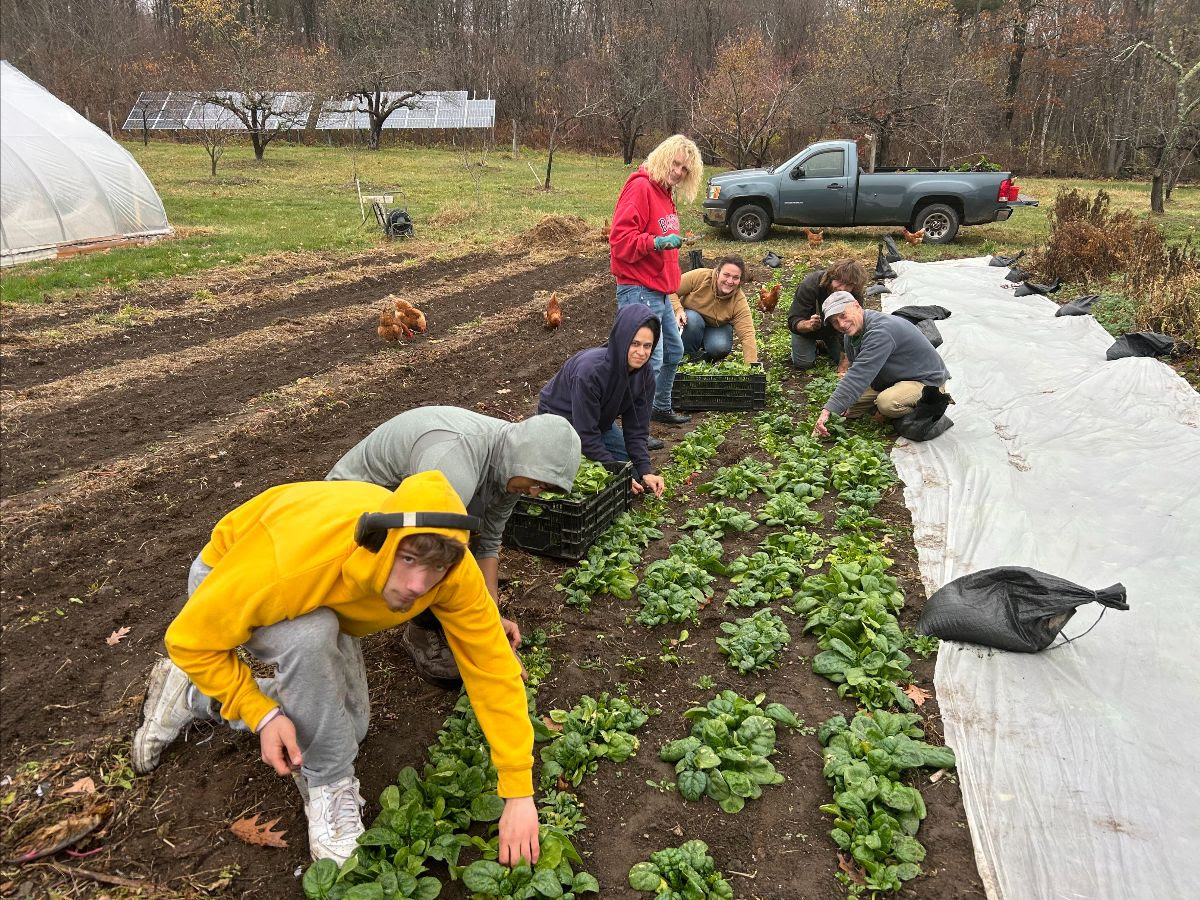
Every Monday morning the farm week starts anew. First to arrive, at dawn, is Justin, staff member picked up from Stetson School by Julie, then Stu, who has been here for 5 years as a working shareholder, Danny, who volunteers half his day and Paula, staff member, Marcia and Jim, working shareholders, and then the two Stetson volunteers (coming since 2012) with either Gary or Laurie by 9 am. Danny and Stu might meet with Jack to go over the day’s carpentry project, Jim will soon be off either cutting hay or wood, and the rest of us head out for chores and picking for the CSA. Lunch for 12, hopefully on the front lawn as weather permits, and we have already mixed generations separated by several decades and experience levels, the whole time in deep conversation about myriad topics.
|
|
 |
|
Harvesting spinach with the Stetson students in late November
|
|
|
The week continues with the addition of Drew, Marissa, Marj, Amanda, Matt, Leslie, Devra, Nick, Maria, and by Saturday morning we end the week with Sophie, Brandon, John, Holly, Shantel and Alexandria, getting us set up for success for the next Monday.
This collection of exceptional human beings from age 8 to 81 raises food for 140 families for 22 weeks, another 60 for the month of November, tend 100-150 laying hens, 200 “meat” birds, 8 rambunctious pigs and 115 adorable turkeys. They cut and stack several acres of hay, several cords of wood, tend 100 fruit trees and 2 acres of vegetables, and preserve an untold poundage of food for a year.
|
|
 |
|
Collecting hay in the pond field
|
|
|
The miracle starts with the microbes in the rich soil, and includes rain, animal fertility and personality, the proud trees, the nutrient rich vegetables, fruit and herbs. It continues with the meaningful work, the sense of purpose, the health-giving exercise and copious consumption of food on and off the premises, the human connection where bodies are busy and conversation can flow in all directions. The skill building crosses back and forth between the generations and we all learn some history while staying current with present events and emerging trends. At the end of each day, Justin can usually be heard saying, “This was a good day.”
|
|
|
Education
Most people in our country today are participants in the industrial food system which emphasizes convenience over quality. At MHOF we attempt to not only raise and prepare the most nutrient dense and tasty food available, but teach others about how to do it through our weekly newsletter, a constant flow of college and high school groups onto the farm, and periodic farm workshops. We have an active YouTube page also here and you can stay up with us on facebook here and Instagram here.
|
|
 |
|
Clark Students cleaning onions in late October
|
|
| Feeding the Hungry
Income and wealth disparity in the US is growing consistently. With help from many of our donors to the Many Hands Sustainability Center, we have been spending a large portion of our resources each year supporting on-the-ground, community-led hunger relief organizations. This year we provided $10,000 worth of food to the Woo Community Fridges in Worcester, and began what we hope will be long-term donation relationships with the Barre Food Pantry, the Worcester Pleasant Street Neighborhood Network Center and a CSA SNAP Assistance Project.
|
|
 |
|
Community fridge before share arrival
|
|
 |
|
And after
|
|
| Land Access
As Julie and Jack now have a combined age of 153, we have been stepping up our concern about future land access on this farm. We are closing in on a Conservation Restriction with Mount Grace Land Trust in Athol geared to prevent housing development and promote farming on our55 acres here, and are lending 20,000 square feet of vegetable land plus use of our walk-in cooler and water system to Marissa and Drew for their own budding farming operation.
|
|
 |
|
Drew and Marissa (Tending Tomorrow Farm) at the Barre Farmers Market
|
|
| Training At Risk Populations
For years we have had a close working relationship with the Stetson School in Barre. Every Monday two volunteers and a staff member come to work on the farm, experience hard work and responsibility, and have lunch with us. From time to time we hire a Stetson School trainee who has graduated high school, but hasn’t left yet. For the past year we have been employing Justin full-time and he has become an essential member of the farm staff as well as Julie’s farming partner. Brandon also comes every Saturday and some holidays to work. These two young men have learned much here and we are proud to have met and employed them. |
|
 |
|
Justin approves the pigs’ comfy quarters
|
|
|
We have been on our land for 44 growing seasons now, raising our four children here as well as many new farmers. This year, with some ill-timed health issues. excessive summer heat and no rain, and severe livestock predation, we considered hanging it up. Instead, spurred on by a long-time friend and customer, we appealed to our friends and customers for assistance in upgrading our irrigation and our fencing and animal predation protection. We received an overwhelming response which, along with a blessed rain on at least a weekly basis since October 1, helped pull us out of the financial hole we were in and prepare for new systems in 2026. With all these miraculous people around us, community farming seems to be in our long-term future here.
Thanks in advance for considering a donation to the MHSC, our non-profit arm, here.
Jack and Julie
|
|
| To learn more about our work visit the Many Hands Sustainability Center page on our website. You can also donate to support specific projects. |
|
|
|