|
|
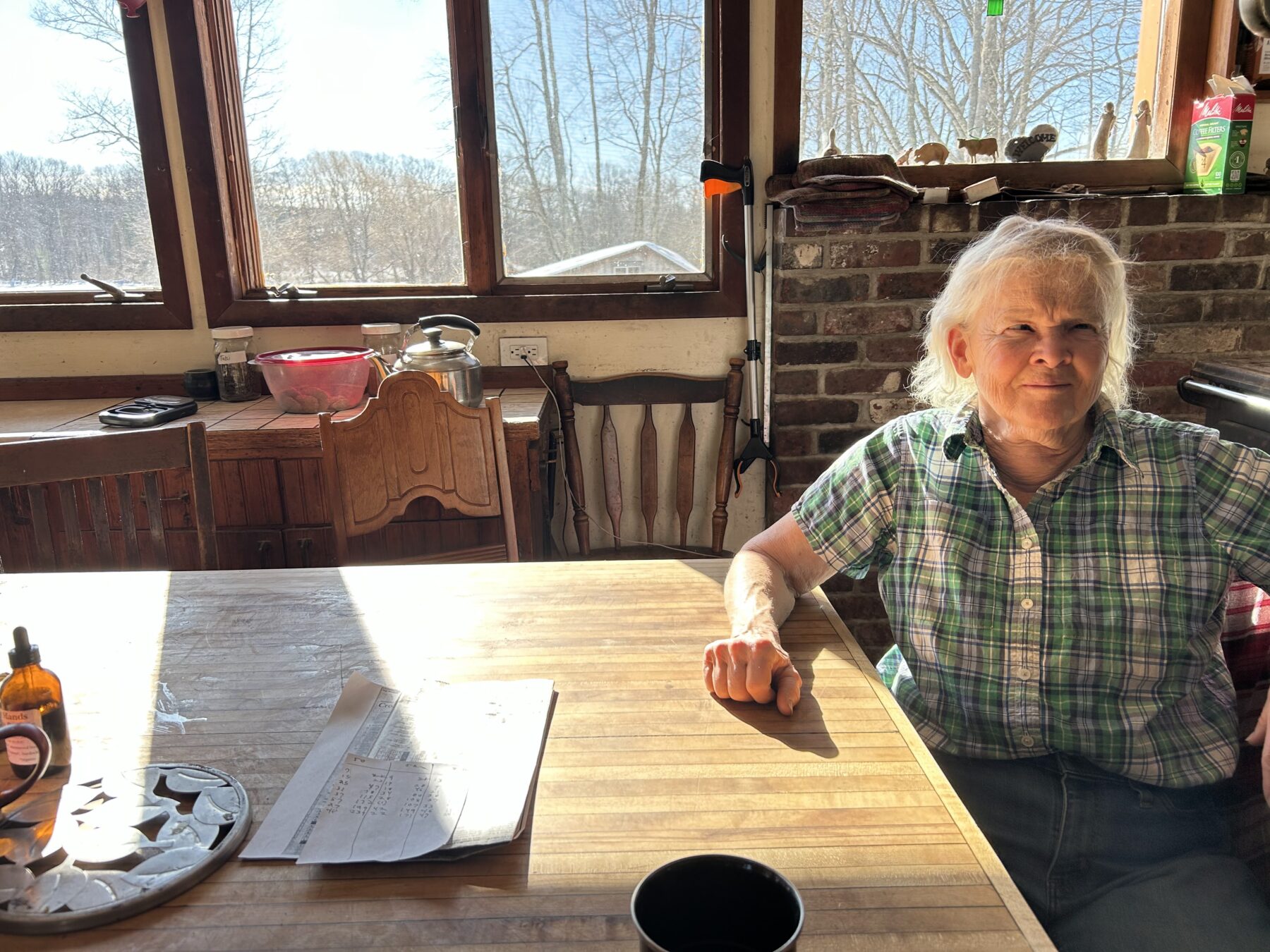
Anyone who has spent any time with Jack, especially while in our house in the winter, will hear him wistfully wishing that our passive solar house design, that we actualized in 1982, would be universally accepted as a very sane and also free way to heat your house. We have saved thousands of dollars over the past 44 years with this design, and hopefully had an impact on fossil fuel resource use too.
Saturday morning when it was hovering at 15 degrees Fahrenheit, Jack took this picture of me sitting at the kitchen table, stripped down to my short-sleeved shirt to beat the heat.
|
|
|
|
It is true that we have that kitchen stove which you see in the background that we use for cooking and hot water, and some extra heat, but we could let the stove die for many hours of the day if we were just concerned about staying warm.
Come by on one of these sunny winter days and see for yourself, but be sure to dress in layers and be ready to take off your shoes and socks. And Jack is guaranteed to be available to explain how we built this into our house. Or you could look it up in our book, for that matter. https://mhof.net/product/many-hands-make-a-farm/
|
|
|
|
|
|
Expressing Gratitude – John
|
|
|
John, a 2025, MHOF working shareholder, called me and Jack up breathless on Thursday evening to share with us that he had arranged for his employer, a cannabis growing facility, to set the MHSC as their charity of choice for the month of April. We will add more detail as we get it, in case you would like to sample their product. Thank you, John, for believing in the farm and our mission, and gathering this financial opportunity for our non-profit work.
|
|
|
|
|
On Intelligence
by Jack Kittredge
A recent article in Current Biology tells of Veronika, an Austrian cow that Gary Larson might have featured in The Far Side. When she gets an itch Veronika wraps her tongue around the handle of a 5 foot push broom, picks it up, and selects either the brush or the stick end to scratch her hide.
Reports a study by Viennese researcher Antonio J. Osuna-Mascaró:
“We recorded 76 instances of self-directed tool use over seven sessions of 10 trials. Veronika manipulated the tool with her mouth, using the tongue to lift and position it before securing it laterally in the diastema between the incisors and molars, creating a stable grip that allowed precise control of the distal end…she applied the tool exclusively to regions on the rear half of her body (the rump, loin, thurl, udder and navel flap), areas difficult to reach otherwise. Moreover, she used the brush end to scratch her body more than the stick end, demonstrating goal-directed, context-sensitive tooling.”
|
|
|
|
|
Despite the formal descriptive language used, the study goes on to reveal the authors’ excitement at observing this behavior and discusses the human tendency to underestimate what livestock can do.
I’m glad that this research is progressing, but I am a little surprised that scientists consider Veronika such a wonder. I think most farmers would tell you that their animals are intelligent. Perhaps not so much at things that we would identify, like using tools so creatively, but certainly at solving their problems given what we allow them – hiding and protecting their young, sensing contaminants and toxins in their feed and surroundings, finding and using materials to build secure nests.
Rather than Nature having, as Genesis proclaims, provided us with a world to steward and control, what we are learning — as we delve deeper into sciences such as organic chemistry and soil biology — is that we are part of a very complex system we barely understand. The processes that living organisms — even very simple ones — control are vital to our survival. For starters think fungal carbon sequestration, plant oxygen production, and animal nutrient recycling.
Compared to those, what have humans contributed to benefit the world? For me our specialty, intelligence, so far draws a blank.
This reminds me of a fable attributed to Lynn Margulis, the great evolutionary biologist from our own University of Massachusetts. After a terrible nuclear holocaust the remaining organisms gather to agree on a plan to repopulate the earth. There is much discussion, but finally only one resolution is found to be necessary and receives unanimous consent: “Next time, no brains.”
|
|
|
|
|
|
Many Hands Sustainability Center
|
|
|
|
|
|
|
|
|
Angie enjoys labeling eggs for the Woo Fridges while Devra does battle with the ones that are too large to fit in the boxes
|
|
|
|
|
|
|
|
|
|
|
Reason number 2 to join the MHOF CSA
Looking for a great gift idea? Give the gift of good health to a loved one and buy them a share in the MHOF 2026 CSA.
|
|
|
|
|
|
|
|
|
Purchasing a share through SNAP/HIP
|
|
|
|
|
|
|
We appreciate your early order for a 2026 summer, fall, flower, or egg share now at the following link. https://mhof.net/community-supported-agriculture/.
Please be advised that flower and egg shares are only available with a vegetable share, not as separate items.
|
|
|
|
|
Outdoor planting calendar at MHOF – 2026
February
- 20 – In hoophouse
- Spinach seed, lettuce, Asian, chard, kale, collard plants
April
- 6, 7 or 15 – peas
- 17 – winter lettuce plants*
- 20 – mokum and Newhall carrot seeds, onion sets
- 24 – arugula seeds, Early Wonder tall top beet seeds, cilantro seeds, collard plants, kale plants, Swiss chard plants
- 28 – radish seeds, Hakurei turnip seeds
May
- 1 – corn seeds. Kohlrabi plants, parsnip seeds, purple top turnip seeds
- 4 – Asian green plants
- 5 – Eastern Magic Broccoli plants, fennel plants, freedom lettuce plants*
- 8 – Early Wonder tall top beet seeds, mokum and yaya carrot seeds, potato pieces
- 11- Snow crown cauliflower plants
- 12- Asian green plants, Brussels sprouts plants, parsley plants
- 18 – basil and tulsi, leek plants
- 22 – arugula seeds, green and pole bean seeds, cilantro seeds, blend lettuce plants*
- 24 – cabbage plants
- 25 – Early Wonder tall top beet seeds, yaya and calibra carrot seeds, celery plants, onion plants
- 26– radish seeds, hakurei turnip seeds
- 27 – Covino broccoli plants, celeriac plants, catnip, sage, marjoram, summer savory, German thyme plants
- 29 – flower plants
June
- 1 – Fiesta broccoli plants, kohlrabi plants
- 2 – cucumber plants, eggplant plants, summer and winter squash plants, tomato plants in field and hoophouse
- 5 – melon plants, pepper plants, sweet potato slips
- 8 – snow crown cauliflower plants
- 9- Asian green plants, cabbage plants, fennel plants, deluxe lettuce plants*
- 10 – Early Wonder tall top beet seeds, green magic broccoli plants, yaya, mokum and newhall carrot seeds
- 17 – arugula seeds, cilantro seeds
- 19 – green bean seeds
- 22– radish seeds, hakurei turnip seeds
- 23 – celeriac plants, purple top turnip seeds
- 24 – Lutz Green leaf beet seeds, Bangor carrot seeds
- 26 – cabbage plants, celery plants, freedom lettuce plants*
- 30 – cucumber plants
July
- Summer squash plants
- 3- Early Wonder tall top beet seeds, bangor and bolero carrot seeds, kohlrabi plants, rutabaga seeds
- 7- Asian green plants, basil and tulsi, Waltham 29 broccoli plants, Umpqua broccoli plants, deluxe lettuce plants*
- 9 -Green bean seeds
- 14 – snow crown cauliflower plants, fennel plants
- 15 – arugula seeds
- 17 celeriac plants
- 21– radish seeds, Hakurei turnip seeds
- 27 – cabbage plants, summer lettuce plants*
- 28 – cucumber plants
- 29 – Early Wonder tall top beet seeds, bangor carrot seeds (2 beds), celery plants
August
- 4- Asian green plants
- Summer squash plants
- 11 – arugula seeds, cilantro seeds, summer lettuce plants*
- 18– radish seeds, hakurei turnip seeds
- 21 – cabbage plants, summer lettuce plants*, blend lettuce plants*
September
- 1- Asian green plants
- 3– radish seeds
- 8 – arugula seeds, cilantro seeds
- 9 – lettuce blend plants*
- 18 – freedom lettuce plants*
October
- 5- Asian green plants – hoophouse
- Winter blend lettuce plants* – hoophouse
*all of our lettuces come from Fedco this year and all are blends
|
|
|
|
|
Valentine’s Day is coming and we have good gifts for your loved one!
|
|
|
|
|
|
|
|
|
|
An Annual Homesteader’s Preservation Calendar
|
|
|
Pork Stock
I have covered this pretty extensively over the past couple of months, but want to get this into the Homesteader’s Preservation Calendar for your records. We end up with up to 8 pig heads when we slaughter and sell our pork. We also ask Adams Farm to return to us any tails, trotters, bones from meat that is prepared for ground pork, etc. We get out that 5-gallon pot and put in usually a half of a head and some various bones, trotters, tails, etc. to fill up the pot. I like to immerse everything, put the tight fitting lid on, fill it will water, add a handful of sea salt, and a half cup of MHOF vinegar and cook it on the woodstove for about 18 hours. Then I take it off, cool it, extract the meat and run the broth through the colander, take out and discard some of the fat (we give it to dogs and chickens) and run the whole business through the Vitamix, pouring it off into another 5-gallon pot, once more through the colander to catch any stray bones. The dogs and chickens then sort through the bones, and the broth goes into 1-quart plastic containers. There is a superb amount of collagen in this stock, lots of protein, and lots of flavor for your next soup.
|
|
|
|
|
|
|
Matt’s recipe
Roasted squash with kale and farro
Ingredients:
1 medium (or 2 small) MHOF winter squash
1 large bunch MHOF kale
Note: the pictures show fresh vegetables but you can use preserved frozen diced squash and kale. Just thaw and drain excess water.
1.5 cups uncooked farro
3/4 cups chopped nuts(walnuts or pecans)
Olive oil
2 Tbsp MHOF garlic powder
1 oz chopped sage
Salt and pepper
1. Preheat the oven to 400 degrees
2. Peel and dice squash into bite sized pieces. Put into a bowl. Stir in 2 Tbsp olive. Stir in garlic and salt and pepper to taste.
3. Stem and cut up kale and add to a separate bowl. Stir in 1 Tbsp olive oil and then add salt and pepper to taste.
4. Spread the contents of the squash bowl onto a large sheet pan and put in the oven on a middle rack
5. Start to cook the farro according to the instructions on the package.(Once cooked, put into a large mixing bowl and stir in 1 Tablespoon olive oil and chopped sage. Put aside for now)
6. After 15 minutes in the oven remove the squash, flip it with a spatula for even roasting, place back in the oven.
7. After another 10 minutes of roasting, top the squash with the kale and then the chopped nuts. See the picture.
8. Roast for an additional 8-10 minutes. The squash should be firm but fork tender.
9. When finished roasting, mix the squash/kale into the large bowl with the farro and serve.
Note: For a higher protein, non-vegan option, at the last step, mix in 1 lb of cooked, diced MHOF chicken or 1 lb. cooked MHOF ground pork. The picture of final dish has the chicken option
|
|
|
|
|
|
|
|
|
|
|
|
|
|
|
|
|
Monday, we cancelled work, for obvious reasons, and proceeded to plow and shovel snow all week. Special thanks to son Dan who spent an hour cleaning up after our plow guy with the tractor. That was Tuesday, and then again on Friday, Devra, Marissa, Angie, and Clare and I grabbed shovels and did the final cleaning in front of the woodsheds, the barn, the garage and the hoophouses.
Tuesday Jack and Clare took apart our old computer in an attempt to get it fixed.
|
|
|
|
|
and we made another batch of chicken stock. And I finished up our planting schedules and maps for the vegetable fields.
Marj and I had a great marketing meeting with Gretta and Lida from Tip Top in Brookfield to discuss the Brookfield CSA site and also selling produce weekly to Tip Top during the season. Marj and I have a regular marketing meeting each week to work out all of the many details of marketing our long list of products, and to keep the website fresh.
Friday saw us topping off indoor wood piles, packing eggs for the Fridges, making up another 16 quarts of chicken stock. Then while Jack and I ran off to a funeral everyone else went out and froze to death in the pond orchard (always seemingly 20 degrees colder than the home orchard with its beautiful south face) and pruned two apple trees. In the afternoon we picked up all the ladders and brought them over with the tractor to prune 2 peaches – and it was actually kind of nice. Though on the way out to the orchard, I fell down in the deep snow, and Harriet immediately thought it was a fun game and jumped all over me. The nice thing about falling in deep snow, however, is that it is imminently soft and comfortable!
|
|
|
|
|
Devra is becoming a pro with the lopper extension (whose head looks just like a parrot’s)
|
|
|
|
|
This is taken from the top of my ladder of Clare and Marissa trimming peaches
Julie
|
|
|
|
|
|
|
|
|
Monday morning I was happy to spot this cute little bird feasting off of dried flower seeds
|
|
|
|
|