War

This may be the only newsletter you read that moves from house cleaning to war, but I try to share what is uppermost in my mind during any week, and I am overwhelmed by the news of the US attack on Iran. It seems that from the inception of this country, even before we were a country, we felt it our “manifest destiny” to take whatever we wanted, and kill whoever stood in our way. As a farmer, I learned the hard way long ago that the best way to work in nature is to work with it—promote plant health instead of nuking bugs, and use mulch instead of spraying weeds with chemicals. And expressing my will in a way that dominated others — farm staff, NOFA staff, community chorus members, high school musical students, and our own family — has always been a recipe for disaster. I learned in Sunday School a long time ago that we are called to treat each other as we would be treated. I think that the United States, as the most militarily powerful country in the world, must return to these time honored lessons if the best parts of our culture are to survive.

Expressing Gratitude

It goes to Matt this week. I went down to the greenhouse on Friday and found Chyorny in there with the door open and the job of doing in our 6 boxes of seedlings finished. After chasing him around with the hose on full blast and then out of the greenhouse (it did feel good to spray him down!) I solicited Matt to help us come up with a cat proof fix on our sliding screen door to the attached greenhouse. About an hour and a half later, he had retrofitted our somewhat low-quality screen door with stoppers to keep a strong cat from pushing the door off its track, and had added a hook and eye closure on the door that will keep even the most intelligent cat from getting in to play in the dirt. I can’t get over how lucky Jack and I are that so many competent people want to come and be part of our farm. And in this case, our seedlings are safe in 2026!

Biology and Paternal Care

by Jack Kittredge

Somewhere over 95% of earth’s mammal species rely almost exclusively on the mother to nurture and raise the young. A good number of studies have been done on the biological basis of this nurture. Most animal behavior is mediated by chemicals in the brain and maternal care is located in a brain region called the mPOA (medial preoptic area) of the hypothalamus, which undergoes dynamic hormonal and epigenetic remodeling during pregnancy.

Very little research has focused on paternal care by males, however, either ‘sexually naïve’ ones without breeding experience or ‘sexually experienced’ ones, whether interacting with their own biological offspring or as ‘alloparents’ (think uncle) dealing with another male’s offspring. When witnessed, male paternal activity can range from care and attention to violence and even cannibalism.

A team of researchers from Princeton decided to investigate this field and have published in Nature a study of cues which regulate paternal behavior. They chose African striped mice as the subjects, a variety of rodent that has been observed exhibiting diverse behavior from grooming to attacking their young.

They placed various male mice with striped mouse pups. Not surprisingly, as with the mothers, this precipitated neural activity in the male’s mPOA. Heightened activity corresponded to periods when the mouse was exhibiting helpfulness; when lower, hostility. This response had nothing to do with the past sexual experience of the subject: ‘naïve’ as well as ‘allo’ mice showed the same reaction as biological fathers.

Encouraged that the study found a correlation between brain activity and behavior, the team went further and looked at the changes in behavior and their connection to brain biochemistry. The more caring mice showed lower levels of a gene called Agouti, which is traditionally associated primarily with metabolism and skin pigmentation. The study showed that solitary males possessed a lower level of Agouti, compared to those who lived in groups.

To determine causation: whether a high Agouti level was the driver of hostility, or if the emotion somehow increased the gene’s prevalence, the team artificially boosted Agouti through gene therapy. Previously nurturing mice became less interested in the pups or even volatile regarding them. Later, mice relocated from communal to solitary living conditions experienced lower Agouti levels and became more interested in the pups again.

What can we make of all this? The team of course properly calls for more research and discourages early conclusions. But what appears possible, at least in mice, is that fathers, who Nature does not always grant a positive attitude toward caring for their offspring, can be moved in that direction by biological means.

Whether this flows from less stressful living conditions, better nutrition, or other environmental conditions, perhaps human behavior can occasionally be improved by altering the way we live.

All of us know people who had an absent or abusive father and who are suffering thereby. If we could prevent even a small portion of that, and replace it with a natural level of caring, how much pain on both sides could be removed?
2026 MHOF CSA

Reason number 7 to join the MHOF CSA

Join the MHOF CSA and gain access to our farmers. You are welcome to come to the farm on any work day and follow us around and help out, ask questions and then take your share home.

Throughout our existence as a farm, we have had an open door to anyone who would like to come and “get a taste” of things, all the way to regular volunteering in exchange for a large CSA share.

We appreciate your early order for a 2026 summer, fall, flower, or egg share now at the following link.  https://mhof.net/community-supported-agriculture/.

Please be advised that flower and egg shares are only available with a vegetable share, not as separate items.

We are quite enthusiastic about our collaboration with Tip Top Co-op in Brookfield, now for the second year as a delivery location for the CSA.

Yes, we will have them again this year. They will be ready on July 13. We have 40 left for sale

Many Hands Sustainability Center

Thanks to Beth, and Andy and Margo who donated a total of $175 this week toward our present goal of $2,000 in order to secure a match of $2,000 from a local business. Just $1,825 to go!

You can donate here

– https://mhof.net/many-hands-sustainability-center/food-access/

Information of interest from the outside world

Resilient to the Core: The Gut-Pelvis Connection in Women’s Health

https://join.sibosos.com/page/667193-register-to-watch-free?delivery_id=3354026472&utm_medium=email&utm_campaign=3071944-replay-the-gut-pelvis-connection-in&utm_source=lists%2F141951-Gift-you-signed-up-for-from-Shivan-Sarna&simplero_object_id=su_ZVn75QsGpvxZtHtMv6xcSznp

Regarding Reverse Osmosis and mineral balancing

Recently I went to the dentist and was told that the bone in my jaw was receding at an alarming rate. I was shocked, and started doing research. As I closely manage my diet and my supplementation, and eat tons of mineral dense vegetables, I was a bit flummoxed. The dentist asked if we use reverse osmosis for our water system. Indeed we do, softening the water first to make it suitable for that, and have been doing so for at least the past 25 years. He suggested purchasing Concentrace minerals to add to the drinking water. We bought those forthwith and started adding them. And then I came upon a podcast on the use of fulvic and humic liquids as supplements for mineralization. I have bought these BEAM mineral supplements and have just started adding them to our regimen. So I can’t speak to efficacy yet, but wanted to share this information for others who may have been using reverse osmosis water and may want to address any deficiencies that might have arisen because of this practice. Here is a podcast on this topic that might shed some light.

Are Minerals the Missing Link? https://www.beamminerals.com/blogs/podcasts/are-minerals-the-missing-link

A reminder from John Kempf, my favorite farming mentor about basic regenerative agriculture practices

  1. Mineral nutrition supports plant immunity

  2. Healthy plants resist insects and disease

  3. Microbial metabolites are a more efficient source of nutrition

  4. Quality drives yield

  5. Healthy plants create healthy soil

I have only experienced success with working with these principles

An Annual Homesteader’s Preservation Calendar

This week I would like to talk about edamame or green soybeans. There is a lot of controversy around soybeans in the deep nutrition community. The vegans and vegetarians have long held soybeans as a staple in a healthy diet. The Weston A Price folks are pretty anti-soybean. I figure you can come to your own decisions around them. We give them out one or two weeks during the CSA as they have a short season. Recently the deer have been dining on them, so they have been scarce around here, but hopefully our solar motion-activating lights that we are liberally scattering around our growing areas will keep the deer at bay in 2026. If you grow them or receive them in your CSA share in the pod, here is how you deal with them.

Bring a pot of water to boil. Immerse the beans in the water and continue boiling them for around 5 minutes or until you can pop them out of their pods with thumb and forefinger. Cool them down and sit down with friends to shell them. You can then eat them cool, or rewarm and serve with some butter, or put them in freezer containers to enjoy later.

Recipe of the week

Sorghum Nourish Bowl with Bone Broth, Chickpeas & Green

Jennifer’s Recipe

Save this recipe for when you receive fennel in your share!

Bionutrient Food Association Conference Week 8

Diane and Ian Haggerty

Farm Doins

Though it started out bitter cold on Monday, we had a very accomplished day. Stu and Danny decided to move their chicken house door-making project to the basement, where Stu, of course, complained that he got too hot in the sun!

The rest of us tackled extracting our November accumulation of firewood out of the huge snow pile for at the end of the driveway. First Matt, then Clare worked with the tractor while Devra, Paula, Gary, Ross and Tyler used iron bars, shovels and brute force to get the dislodged chunks of wood into a pile for cutting, splitting and processing for the wood shed. We all felt a great sense of relief at finally breaking the back of that job that has dogged us because of the huge snow banks. We have one more day to finish the job.

In the afternoon we pruned a few trees in the home orchard after floundering out through the deep snow.

During the week Clare made progress on our organic certification application, Marj signed us up for Venmo, Stripe, SNAP and HIP at farmers markets, and continued on website details. Jack continued on signage for tools in the shed. I completed the workshop list for 2026 which we will publish this upcoming week.

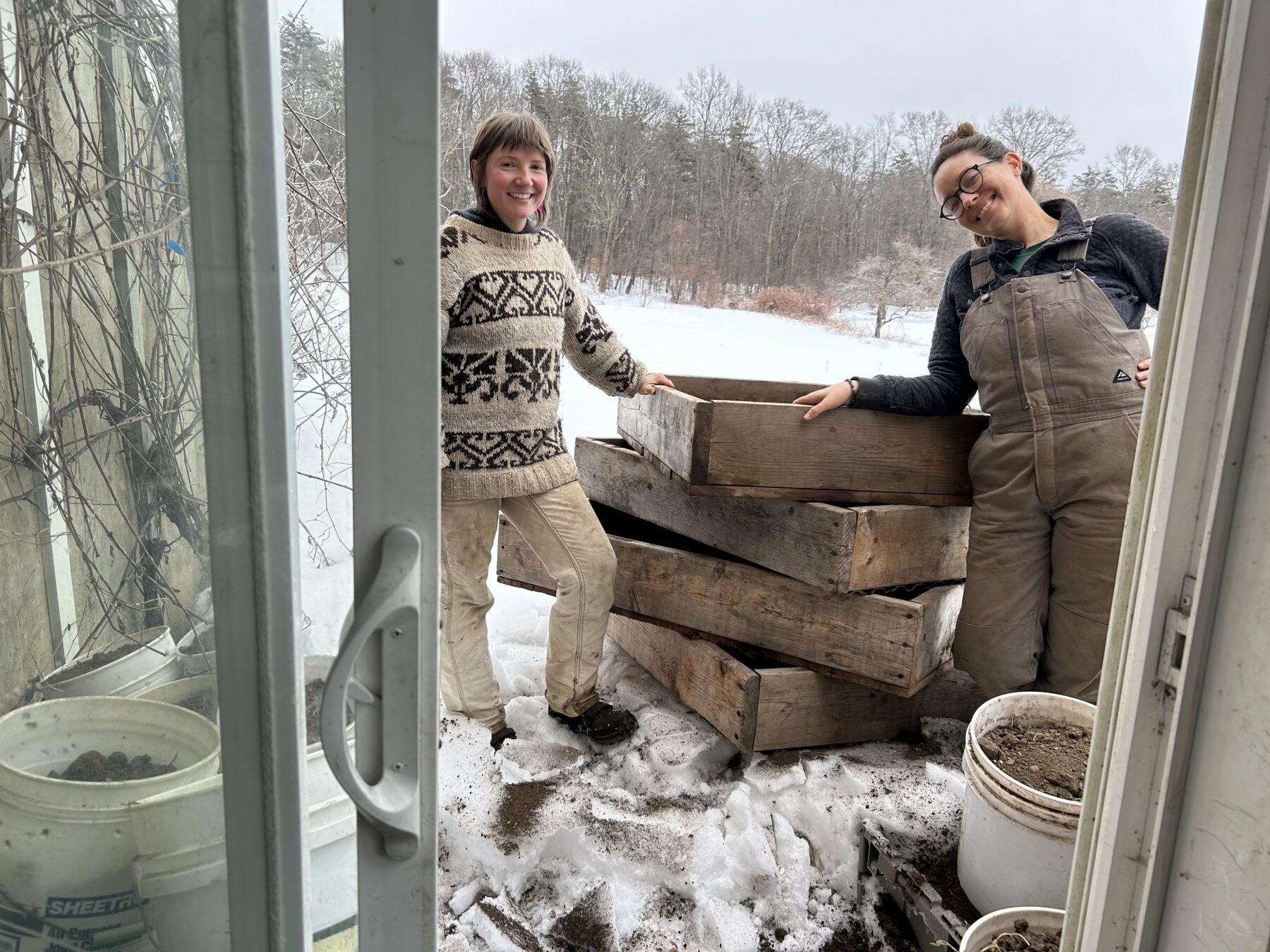
Friday found us doing food tasks like peanut butter ball production, video making, more snow and ice and sleet shoveling, and cleaning out the greenhouse of our over-winter lettuce boxes and starting of new seedlings to replace the lettuce, chard, kale, collards and Asian greens that the cats took out.

Marissa and Amanda after moving the big lettuce boxes out of the greenhouse

We spent a lot of time gnashing our teeth on Friday because the promised temperature of 45 degrees turned out to be 30 degrees and misty freezing rain all day. Patience, patience, on 12 more days until spring!

Ice covered grape vines

Julie