Many of you have been following our blow-by-blow account of mishaps and misfortunes on the farm in 2025. But let me list it out again if you have missed it.
The year started wonderfully, as farming years often do, when much of the hard work of preparation in January through March is under one’s belt, and nothing has had a chance to go wrong yet. Our CSA was well subscribed, our fruit trees and bushes were all carefully pruned, the tarps were down on the vegetable fields, and all looked rosy.
Then it started to rain, and snow, and snow again, throughout April (our peas were tortured by 4 snowstorms after planting). I think there were 16 Saturdays in a row with major precipitation. The first big blow was the second week of May when it rained and blew all week, right as our apple trees were flowering. We ended the week with no pollinated apples, and only minimal peaches and pears. We were well advanced with spring planting by then, and even a lot of mulching, but by the end of May a lot of our vegetable fields were underwater and one spring veg crop after another succumbed to microbial asphyxiation.
And then June came. The heat jacked up to 100 degrees and Jack broke his shoulder. While the vegetables were reeling from the wild weather swings I was spending all my extra energy caring for Jack. Soon I succumbed to Lyme disease. My right leg blew up and I was hobbling in pain for about 5 weeks, all while trying to be a decent team leader. The heat was pretty unrelenting through June and July, and then August came but the heat stayed with us.
Sometime in June it also decided to stop raining. We got maybe an inch and a half in July and almost nothing in August, under an inch. The drought stays with us. We have a meager hose and whirligig set up that I move 5 times per day, trying to catch as much of the farm as possible as quickly as possible. Crop after crop has come in under expectation, with a few exceptions like beets, cucumbers, summer squash, and an array of really nice herbs. CSA weights are down substantially and I dread the beginning of each week as I plan what we can pick to satisfy this commitment.
Predation has also been overwhelming this year. When plants are stunted by drought it happens in the woods, too. Hungry animals seek food where they can: vegetarians brave our three outside dogs to feed each night on our best crops; carnivores finding fewer small critters available for dinner because of the drought smell our pastured poultry and take their chances. We lost 60 young layers in June, 50 young meat chickens in July and 55 young turkeys in August. Each night we tried new configurations of dogs chained to houses and dogs running free to try to stop the massacres. And while the dogs are tied up the deer take the opportunity to free reign on our lettuce, Swiss chard and winter squash, and the coons clean out our crop of early corn. Lack of sales from these losses is very significant.
At 72 and 81 we seriously considered quitting farming after this year. But Kay Masterson sat us down and encouraged us to look at options to keep this from happening any more. Jack, as is his way, has been researching until he is blue in the face to find improved systems – electric fencing to deter animal and vegetable predation, and irrigation for drought. Our plan is to start 2026 with these systems in place. We have slimmed down our staff, our major financial cost, so that we won’t lose our shirts this year, and of course this means more work for us.
We would like to ask your help to purchase and install this equipment. Rough numbers look like we will have to spend about $5000 to do this job adequately. Will you consider making a donation to the farm to help us with these capital expenses? Or, if you are so moved, a donation to general operating expenses would be welcome too. You can make a check to MHOF and send it to us at 411 Sheldon Road, Barre, MA 01005. What we do is, we hope, important in the world. And besides, it is usually quite fun.
Gratitude this week
Keeping it in the family this week, I am grateful to son Dan. We went over to help him with tomato picking and lunch prep for a bunch of folks who were out from the East Boston Community Farm. I realize regularly how close Dan has fallen from the tree. After some picking, a merged lunch from our farm and his, we enjoyed the company of these urban farmers. It was great to see what the next generation is up to, and to know that folks still concern themselves with the best way to work with comfrey, consider how best to make Korean Natural Farming potions, and wonder about Japanese knotweed. And at the end Dan sent us home with oodles of tomato seconds and monster cabbages to process, and then share once they are processed. We gave him extra seedlings in April and May, and now we are reaping the benefits of his excess. It is a wonderful gardener/farmer economy of sharing resources and time and expertise. How nice to keep the generational farming connection going. Thanks, Dan.

2025 MHOF CSA
CSA Week 16
Friday was a great day. It rained Thursday night, not for long, but for maybe ½ inch. And I write this just at the beginning of a thunderstorm on Saturday afternoon. At 3:30 it is very dark and the rain has just started to pour. Elation! That is what all of the vegetables were feeling on Friday and who knows how they will feel by Monday when all is said and done. Talk about gratitude!

We spent all week moving the simple watering system around the farm. But Thursday night I turned it off, hopefully for the rest of the season

Here is my best guess for this week 16
- Lettuce – for larges and mediums. Last week you all received heads of lettuce from which the deer had carefully sampled the centers. I thought about not giving you lettuce, but decided maybe it was best for you to get a front row seat on the predation. Jack has purchased 4 more solar activated lights which we will put up near our chard and lettuce this week. Let’s see if it keeps these very picky and dainty eaters off of our crops!

- Summer savory
- Basil
- Beet greens – try as hard as we can to get that 100’ bed of beets thinned, we can’t seem to get it done. Meanwhile, I served up an entire bunch of them sauteed with onion and summer squash, one slice of chopped bacon and 6 eggs to our Saturday breakfast crew of 5. They are delicious
- And then, a very large beet with beautiful greens for each of you this week – my pride and joy, are these beet

- Broccoli/cabbage/cauliflower or collards
- Kale for all

- We are still cranking out summer squash from our first and second plantings and will have a fresh batch from a 140’ row in the south field coming in this week too
- Chard – still looking and tasting like satin
- Tomatoes – they are speeding up a little bit. Let’s see what this rain does
- Corn – each large and medium share got 1 ear last week – this week the same for the smalls; it ain’t much but it is mighty tasty
- New radishes
- New and succulent turnip greens
- Tulsi – this is an adaptogen. You can put it in your salads and soups or you can make tea to calm the nervous system
- Sage
SIGN UP FOR A FALL SHARE NOW
We have 35 fall shares available for sale. Right now, we are scurrying to replant as many of our beds as possible that are emptying out with great Asian greens, spinach, and lettuce. Some of all of this will go into the hoophouses too. There will also be some storage crops. This week we hope to have planted 5 full beds of spinach. There should be a bounty of this marvelous green this fall.
https://mhof.us2.list-manage.com/track/click?u=05a025b461ae7eacd1d54508a&id=722d4801a8&e=5614a13e14

Mineralization vs. Humification
This fall I am going to leave no stones unturned to make sure that our cover crops germinate. Last fall I was not prepared for the fact that it wasn’t going to rain for two months and wasted a bunch of cover crop seed because I broadcast it and assumed that normal rainfall would cause it to germinate. This year we will make sure we have water on it.
The attached chart is part of an ad at AEA for their fall soil primer – rejuvenate, seas shield and spectrum – but it is a good reminder of what we need to do in the fall to set up next year for success.

Tending to cover cropping
Now until the first week in October is an ideal time to plant cover crops. By the end of Saturday, we had cover cropped about half of our farm. In some cases we undersowed under tall plants like brassicas and tomatoes, and for the bottom of the west field we broadcast cover seeds on the potato and winter squash area that was mowed (the remaining mulch and plant refuse). Right after rain – Thursday night, and before rain – Saturday night, enhances the chances of the cover crops to germinate, right on the mulch, assuring a wonderful fall and winter cover for the soil. This fall we used what we had left over – daikon, field peas, cool season soil builder mix from GreenCover Seeds, oats, and crimson clover.

Humans and Agriculture
Jack Kittredge
Our recent struggles here with serious drought, unusual in New England, puts me in mind of a fascinating book, Dark Emu, by Bruce Pascoe. In this 2014 work Pascoe argues forcefully against the ruling historical opinion that Australian aborigines never practiced agriculture or exercised engineering skills in their 65,000 or more years of dealing with their unique, quite dry continent. A short Ted Talk by Pascoe is here if you would like a sample of his thinking.
Historians are pretty firm abut agreeing that the agricultural revolution began some 10,000 to 15,000 years ago in the mid-East, China and perhaps the Americas. They date this important technological advance to the ending of the ice age and the withdrawal of glaciers from the temperate regions of the earth. Geologists admit that dry Australia, however, never suffered serious glaciation despite the climate being cooler than now.
Does this allow one to think that perhaps farming might have been invented first there? Pascoe suggests just that.
Pascoe bases his conclusion on numerous accounts, written over 250 years ago by the continent’s earliest white settlers, testifying to things such as discovering 9 miles of “stooked”(stacked or sheaved) grain and “tilled” yam fields stretching to the horizon. Somehow those writers couldn’t bring themselves to call this agriculture. No sheep, perhas?
Another contemporary account describes a rock weir and dam built across a stream with holes in it into which “blacks” placed long sticks which were then bowed and connected by lines to underwater triggers. Fish would swim into these traps, release the triggers, be automatically snagged and thrown up out of the water as the stick suddenly straightened up. They were then casually bagged by the attending black before the trigger was reset. Unaccountably such observations were cited as proof of aboriginal “laziness” and indolence. Perhaps what they really lacked was a patent office.
It is always a pleasure to learn about the creativity of others trying to wrest a living from the land and negotiate the climate, predators, weather, competitive plants, nutritional value and preservation methods of the harvest. It feels like a bit of an honor to be sharing this calling with others who, we are learning, have been at this for a very long time.
Latest from Ellen
Would you like to join me this Autumn to learn how to eat better for your Metabolic Health?
I’ve decided to bring in many aspects of education, support, and also a different twist on my recipes, to my normal 7 Day Cleanse!
The reason I’m combining these two areas of Metabolic Reset and Cleansing is that even when we eat a generally healthy diet, we’re still exposed to toxins in our environment all the time. This regular exposure combined with a world that’s become more out of balance, which causes our nervous systems, hormones, sleep patterns and daily stress levels to end up being all over the place, takes quite a toll on our bodies.
All details for the “upgraded”
We begin October 13th, and Early Bird and Bring a Friend Discounts are available, so register soon!
Jennifer’s recipe
Autumn Roasted Roots Bowl
As the seasons shift toward autumn, our bodies crave foods that are warm, grounding, and deeply nourishing. This roasted root bowl brings together the sweetness of beets and carrots, the earthiness of potatoes, and the warmth of onion and garlic, all roasted slowly in ghee with fennel, cardamom, and fresh basil. In Ayurveda, roots are celebrated for their stabilizing qualities, helping to pacify the light, dry, and mobile nature of Vata that dominates this season. Ghee adds unctuousness, feeding the nervous system and aiding digestion, while fennel and cardamom reduce bloating and bring a subtle sweetness that soothes the senses.
From a western nutritional perspective, this dish is a powerhouse of vitamins, minerals, and antioxidants. Beets support circulation and liver health, carrots provide beta-carotene for vision and immunity, potatoes deliver steady energy and potassium, while onions and garlic boost cardiovascular and immune support. Ghee, rich in fat-soluble vitamins, enhances nutrient absorption and adds satiety. Even cooking in cast iron contributes valuable dietary iron.
The result is a dish that beautifully bridges tradition and science: a bowl of roasted roots that nourishes body, mind, and spirit. Whether enjoyed on its own or paired with a grain, it’s an ideal way to welcome the grounding rhythms of autumn.

Marj’s Photo Gallery


Farm doins
We have moved into September. This wonderful month focuses on bringing the CSA home – 2 more months of the summer, and 1 month of the fall. That includes weeding and mulching later season crops. See below what we accomplished on Tuesday.

We ran out of hay, and waiting just one day for Dave to fix the power steering leak on the tractor so that Justin could rake our most recent batch. That awaits pick up on Monday.
A big project that I didn’t hope to finish was that of pulling some really nasty grass out of our strawberry beds, transplanting in 200 plants from our old west field bed, and getting those strawberries set for fall. We did it!
We continue to plant, plant, plant – lettuce, tatsoi, mustard, bok choi, spinach, dill. For the next two weeks, as we empty out a bed, we will plant something for fall, or covercrop it for winter. This part is fun to race the sun clock. We also started a bunch of greens for planting in the hoophouses for late fall and winter.
The young layers started to lay in earnest this week. No more egg shortages, should you like to buy. I have been sweating every egg for the past 3 months and can now breathe easy.
We celebrated two of our most favorite virgos this week

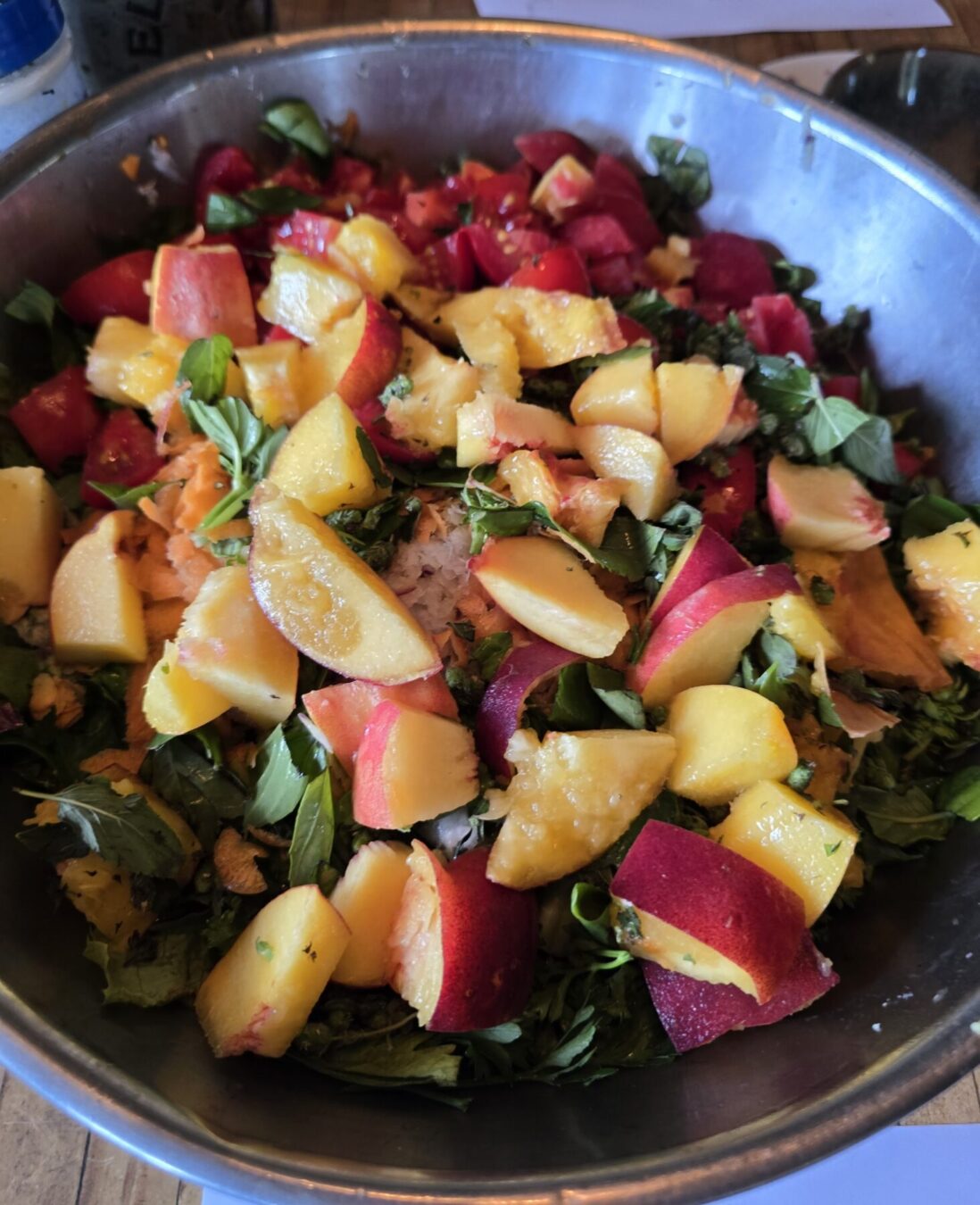
Lunch almost always includes an amazing seasonal salad


Yes, I am happy. The rain has returned, at least for now, no one (that we know of) was murdered in the fields this week, and all is well and getting ever better on the farm.
Julie

Leave a Reply
You must be logged in to post a comment.