July 14, 2025
Weeds and What They Tell You
compiled by Jack Kittredge
Weeds are often a farmer’s worst problem. But for all the damage their competition does to a field’s production, they also do great service. First, they quickly cover any exposed surface with green, photosynthesizing life, preventing the soil’s loss of carbon to oxidation and locking that carbon up in carbohydrates. Second, they provide a thoughtful observer with a detailed local soil map, indicating useful facts about the soil’s characteristics: pH, depth, nutrients, moisture, and tilth.
Dandelion profusion, for instance, famously indicates low levels of calcium and organic matter. Clover and other legumes show up prominently in soils deficient in nitrogen. Dock survives annual flooding better than most plants and indicates where moisture may linger. Many books have been written analyzing what we can learn from weeds. Here is some wisdom about common weeds in central Massachusetts. We will cover three of our favorite weeds this week.
Bindweed (Convolvulus arvensis) is a perennial in the morning glory family. There are two species, field bindweed and hedge bindweed. Both prioritize storing energy in their roots rather than their seed, so mowing doesn’t work well against them. Roots can reach depths of 10 to 20 feet, although the majority of the root biomass is concentrated in the top foot or two of soil. The extensive root system can reduce surrounding soil water content to below the wilting point for many crops. Best control method is to snip bindweed at soil level regularly (every 2 to 3 weeks), slowly depriving it of photosynthesis. It does not do well in partial shade and dense cover crops can reduce its competitiveness. Organic mulch is largely ineffective against bindweed, which has been known to penetrate 18 inches of bark mulch. While field bindweed can thrive in a wide range of soil conditions, it particularly favors dry, poor, or compacted soils, and will not tolerate waterlogged ones. Hedge bindweed likes waterlogged soils, however, and invades wetlands. Bindweed is often found in clay or sandy soils and can handle dry conditions. It does well in a pH of 6 to 7, with a low humus content, and can accept excess heavy metals in the soil. It easily thrives in disturbed soils.
Bishop’s Weed (Aegopodium podagraria) is a perennial also known as goutweed or brown elder. It was promoted as a fast-growing ground cover, but is so aggressive some call it a noxious weed. The plant spreads via underground roots called rhizomes as well as seeds, and digging up unwanted plants often causes them to spread even more because broken bits of rhizomes quickly form new plants. The rhizomes are long, white, and branching. Seeds are small and long, similar in size and shape to carrot seeds, ripening in late summer. It is hardy in USDA plant hardiness zones 3 through 9 and thrives in a variety of soil conditions, but generally prefers well-drained soil that is rich in organic matter. It can tolerate a range of soil types, including clay, loam, and sandy soil, and grows in both acidic and alkaline conditions. While it prefers moist soil and full shade, it can also tolerate some drought and partial sun. Shade is particularly important in areas with hot summers.
Chickweed (Stellaria media) can be variable in size. Early emergence and a rapid growth rate give chickweed a competitive advantage over crop plants in temperate climates. It will have the greatest negative impact on crop yield when it emerges at the same time as, or just before, crop plants. Early establishment also results in larger more competitive individual plants being found. It prefers soil rich in nitrogen and with a near neutral pH. It is less successful in acid soil. Chickweed thrives in moist, fertile soil conditions, often appearing in early spring or late fall, but can also persist in cool, shady areas during the summer as well as in nurseries and greenhouses. It is often found in cultivated fields, pastures, gardens, shady lawns, roadsides, and plantation crops and under trees and shrubs. It is a serious problem in overwintered vegetable and flower bulb crops.
Happy gardening!
Gratitude this week
July is a very challenging month, because it is usually really hot, there is still more prep work than harvesting, weeds are in season, and it is kind of the halfway point in the farming year. This week I was grateful for the overcast early mornings that were my companion as I went out at pre-dawn to let the dogs off their chains and thank them for their nights of hard labor protecting the farm. If you aren’t usually out at pre-dawn in your bare feet, I encourage you to set a date to do so. The birds are starting to sing, the dew is heavy, and the promise of the day to come is in the air. In a matter of two hours there will be the bustle of “making hay while the sun shines”, and the magic slips away for another day.
2025 MHOF CSA

A bit about purslane
Watch on Facebook
Watch on Instagram

Our massive Monday crew harvested the end of the green onion crop
Food this week:
- Asians – either Chinese cabbage or another Asian green
- Kohlrabi for some/carrots for some
- Purslane for some
- Chard
- Kale or collards
- Lettuce for some
- Flowers for flower shares
- Squash
- Cilantro
- Green onions or chives
- Summer savory
- Mint
- Arugula
Jennifer’s Recipe of the Week : Beet, Chard & Fennel Buddha Bowl with Creamy Tahini Dressing
This seasonal Buddha bowl is a beautiful example of balancing nourishment and lightness—ideal for late spring through early fall. The cooling, moist qualities of cucumber and fennel soothe excess heat and support digestion. Beet greens and chard offer bitter and astringent tastes, aiding detoxification and liver support.
Quinoa and black beans bring earth and air elements, making the bowl slightly grounding but not overly heavy—perfect for midday meals when digestive fire is strongest. The tahini dressing adds healthy fats and creaminess, especially balancing for Vata, while fennel’s mild pungency helps prevent bloating from the beans.
This meal is also deeply sattvic—nourishing both body and mind, supporting clarity, calm, and contentment. A gentle digestive spice like cumin or coriander can be added to support agni further, or a pinch of ginger if Kapha is present.

Get the Recipe at Jen Zen Living
Health Opportunities from Ellen
Get some of the great microbiome labs gut biome supplements that daughter Ellen works with at a great discount through July 18th!
All supplements are 25% off through the 18th.
If you don’t have a microbiome labs account, you will need to create an account in order to access the sale. To do that, just go to: http://www.microbiomelabs.
Additional bonus: microbiome test kits are currently a discount of 20% off through the 18th
If you would like to purchase the test kits at this discount, please email Ellen for the discount code: ellen_kittredge@yahoo.
Self Guided 7 Day Cleanse – Begin Any Time!
https://ellenkittredge.com/7-
This summer (beginning as soon as you wish), please join me for your own personal 7 Day Self Guided Cleanse!
BONUS – A FULL WEEK OF BRAND NEW SUMMER CLEANSE RECIPES INCLUDED WITH REGISTRATION You’ll also receive 7 Days of Recipes from my most recent Spring Cleanse, plus the BONUS Eating on a Budget Recipes from the Spring Cleanse, so you’ll be getting 21 days total of recipes when you register.
“This cleanse is the perfect way to kickstart a healthy eating journey! After seven days of guidance and support, I now feel more confident and less overwhelmed when choosing recipes to feed myself. I’m making positive lifestyle changes not because I “ought to,” but because the information I’ve learned from this cleanse has allowed me to understand how my choices impact my health.
The value of this cleanse goes far beyond the price – it’s an incredible bargain – and, as someone with chronic illness, anxiety, and depression, I wholeheartedly recommend it.”
Well, only one disaster this week – Friday morning we found one of our movable chicken tractors emptied out with a few of the dead birds left outside the house. The others disappeared. Marj found some coyote scat nearby – 50 meat birds down in one fell swoop. Because we have been receiving deer depredation in our chard and lettuce, we staked Harriet and Dingo around the vegetable fields and left poor Skippy out with the birds by herself. Her chain was not long enough to reach the bird house that was attacked. Harriet is back loose at night to hopefully support both Dingo and Skippy, with no dead birds Friday night. Sigh.
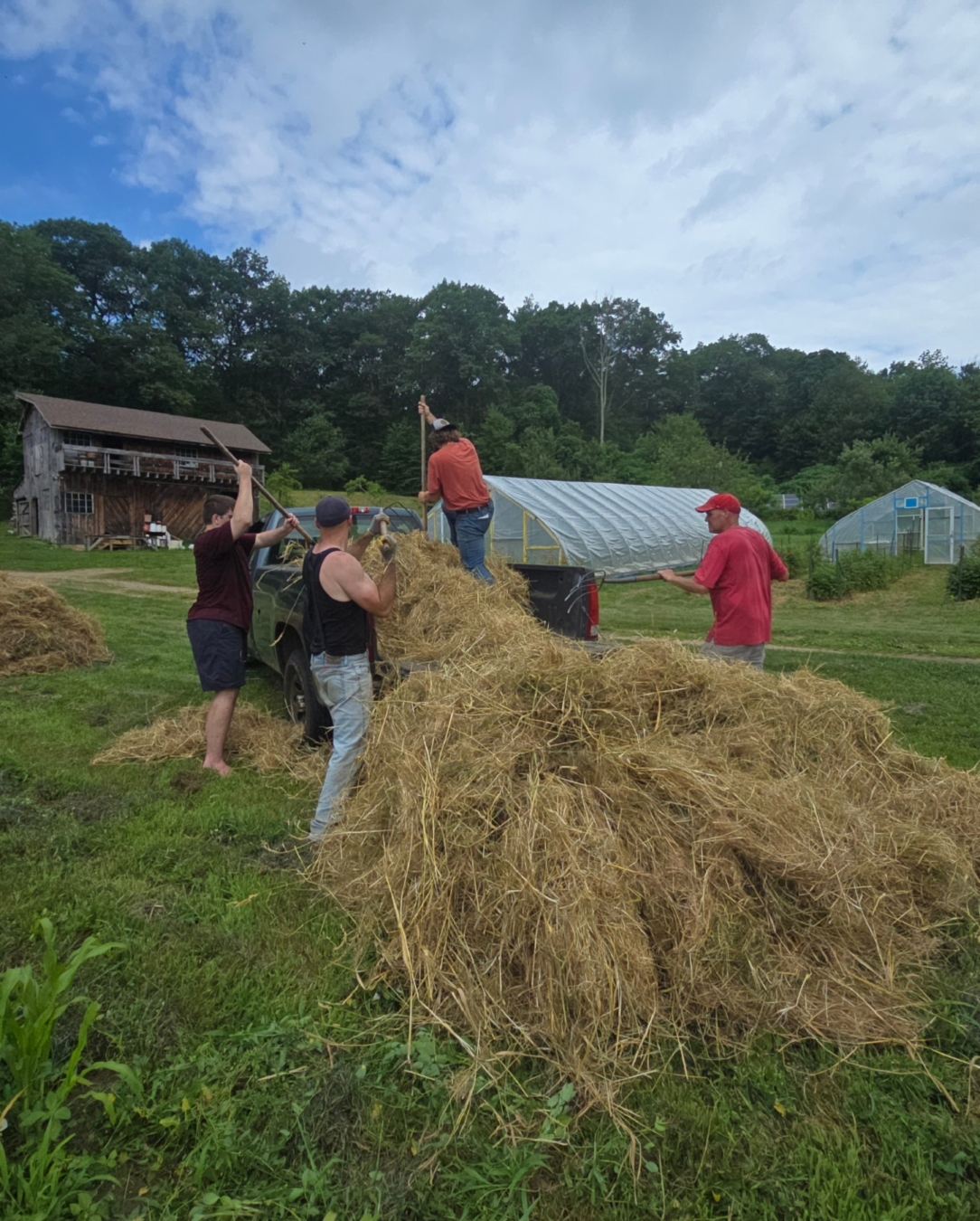
Every free moment between preparing for the CSA is the usual juggle between cutting and raking and picking up hay – we have now cut and collected hay on the entire farm once around

Our stalwart hay crew bringing hay to the corn
replanting, weeding and mulching.
This week we finished up getting the tomatoes weeded and mulched (with tying on the agenda for next week), weeded two beds of celery and mulched a quarter of it, completed care of the corn,

Marissa mowed the pathways in the corn

And then we mulched it

a second planting each of summer squash, cukes, and green beans,
and have weeded half of our sweet potatoes. Our oldest bed of cilantro is all weeded, and our second planting of chard was weeded and mulched. We made some progress on our peppers.
We also weeded our early kale and collard plantings which had been cared for and mulched early, for a second round. Tuesday was a bed prepping day and Saturday we were able to plant some celery, parsley, tulsi, and lettuce.
Bind weed is unrelenting in the garden and north, yet we don’t quite feel like Don Quixote in the struggle with nature.
The mulberry tree is fully ripe with several gallons of mulberries picked and packed away for winter pies, and the blueberries started this week also.
We started new crops of tulsi and basil this week.
Thursday Jack and I picked up the baby turkeys and they are safely brooding in the shed behind the garage.

Watch on Facebook
Watch on Instagram
July is the deep slog month, and we are halfway through it already!
Julie

Leslie strained the digestive bitters while we made peanut butter balls
Leave a Reply
You must be logged in to post a comment.