July 28, 2025
The Great Reset
Transitioning on a farm always has to happen, because people eventually grow too old to keep up the unrelenting pace, or perhaps all of a sudden just don’t want to do any more. Broken shoulders, Lyme legs, unrelenting depredation by wild friends, and impossible weather patterns, have given Jack and me pause this year, despite dedicated customers, a high-class staff of employees and volunteers, and an idyllic place to use one’s talents.
For now, in the heat and dryness of July suffice it to say that everything is up for reconsideration in 2026. To the extent that this rag provides a view into the life of a small diversified, regenerative farm, with all of its ups and downs, let the window continue to stay open.
Gratitude this week
Justin came to us from Stetson. And he has been on a journey for the past year to clean up some perhaps ill-advised behavior from his youth. This past week he came to a new better place legally, and after a short time back home plans to return to Stetson for one more year and also work here full-time for said year. He popped in on Wednesday for one day of what is always focused, fast and executive-thinking based work, before being gone for a week and a half. When Justin is on the farm, I always feel that we can accomplish the way-too-many tasks to keep all the balls in the air. He often asks me, “Julie, what would you do without me?” And my answer is always, “I am not sure, Justin!”
Matt played a starring role this past week too. We spend a lot of thinking time preparing for the next pig move, determining how long we can keep them in one place in the woods until they must move on. Preparing for the next move is always arduous because we are dealing with steep slopes, lots of rocks, trees in the wrong places, etc. Matt has taken on envisioning the entire pig year – June -November, and actualizing it. Wednesday with help he laid out the new “yard” for them. Meanwhile we discontinued their pig feeder for a week and started feeding them in their house, so that on moving day they will rush in to eat and we can close the door on them, and then quickly take down the fence and drag their house slowly to their new location, slap the electric fence up around their new yard, and voila, happy pigs back rooting around and gaining large parts of their keep in woods underbrush. Friday’s move went off without a hitch, and by Saturday they were elated with their new place, frolicking, swimming and flopping in their water dishes, and totally content with life. Discontinuing raising pigs, who get too big to easily manage, is something that an 81- and 72-year-old often contemplate, but Matt has extended that into the future with his excellent management. Thank you, Matt.

Watch on Facebook
Watch on Instagram
Yet More on Weeds and What They Tell Us
compiled by Jack Kittredge
Here are another four common weeds and what we can learn about them and our soils. Thanks to those of you who have liked this item and particularly those who have reminded us that many “weeds” are also nutritious foods and have important health promoting qualities which deserve more a book than a paragraph!
Purslane (Portulaca oleracea) does best in warm weather, and young plants will remain small and stunted when conditions are cool. Although it prefers regular water, it can tolerate drought. Purslane likes dry, sandy soil and is susceptible to root rot if the soil retains too much moisture, so good drainage is essential. A mix with at least 50% sandy soil helps ensure excess water drains away quickly, preventing waterlogged conditions. Adding compost to the mix provides essential nutrients for purslane growth, but it’s recommended to use a moderate amount to avoid over-fertilization. Purslane prefers a slightly acidic to neutral pH (6.0-7.0), which is the ideal range for nutrient absorption. Clay soils tend to retain too much moisture and can hinder purslane’s growth. It grows better in soils with high nutrient levels. Soil phosphorus is a significant factor in its establishment. Purslane grows in full sun in almost any soil, from muck soils high in organic matter to heavy clay.
Ragweed (Ambrosia artemisiifolia) has an extensive root system which helps stabilize the soil, preventing erosion. It grows well on poorer soils and does not thrive on soils high in N, P, or K, liking soils that are low in essential nutrients like calcium and potassium. It tolerates a wide range of soil conditions, including infertile and compacted soils. But it thrives in well-drained, sandy or loamy soil with a slightly acidic to neutral pH (around 5.5 to 7.0), and prefers full sun exposure and adequate moisture, though it can tolerate drought conditions once established. While often viewed as a nuisance, ragweed can indicate a well-balanced soil with good organic matter or it can be an indicator of disturbed or low-fertility soils, especially when found alongside other weeds like crabgrass and mugwort. In some cases, it can be an indicator of a hard pan or poor drainage.
Thistle, Creeping or Canada (Cirsium arvense) is an effective competitor for light, moisture, and nutrients. It quickly out-competes native species and can reduce crop yields in commercial crops and rangelands. It can indicate a few different soil conditions, often suggesting compacted soil, which may be due to heavy clay or disturbance from grazing or machinery. Thistles can also be found in dry areas and may indicate acidic soil. Thistle has a deep taproot and can penetrate compacted soil, breaking it up and bringing nutrients and moisture to the surface, benefiting other plants. Thistles can tolerate dry conditions and may indicate that the soil needs more moisture retention. Thistles are often found in areas that have been disturbed by grazing, poaching, or machinery. While some thistles prefer nitrogen-rich soils, creeping thistle can be found in low-fertility soils. It grows in a wide variety of soil types; clay loam, sandy loam, sandy clay, but grows poorly in the shade and wet soils.
Yellow Dock (Rumex crispus) is often found in disturbed areas like roadsides, fields, and even on the edges of parking lots. Waterlogging can lead to root rot, but yellow dock is a hardy plant that can tolerate cold temperatures and even some frost. While it prefers full sun, it can also grow in partial shade. In essence, while yellow dock prefers a well-drained, fertile soil, it’s not particularly fussy and can survive in many different soil types and conditions, even during the winter. Yellow dock prefers loamy soil, which is a mixture of sand, silt, and clay, providing good drainage and nutrient retention. It thrives in moist environments, but can tolerate drier conditions as well. Yellow dock benefits from nutrient-rich soil, but can also adapt to less fertile conditions, especially if it’s a disturbed area. Good drainage is important to prevent root rot, though yellow dock can tolerate some standing water.
My Interview with Graham Merriweather
We first met Graham when he invited us to speak at a Food Freedom conference in Bellows Falls a couple of years ago. Here is his interview with me a couple of weeks back
Subscribe to Leave It Better Media
My Reading Adventures
This week, still on a Mark Hyman binge, I finished up The Pegan Diet and am in the middle of The Blood Sugar Solution: The 10-Day Detox Diet. I continue to be impressed by his long journey as a functional doctor through veganism, paleo and into the kind of diet that is possible when we grow our own food (except for cold water fish such as herring, anchovies and sardines and olive and coconut oil), mostly consisting of pasture raised meat, eggs, lard, butter, vegetables and berries. I have learned and forgotten this information before from Sally Fallon, Adele Davis and other farm-based nutritionists. As he is incorporating the new science of the gut biome, and reminding us to eat locally from small regenerative farms, I find the information made to order.
2025 MHOF CSA
Thankful for the blessings of nature, this year we can say that it has been the best cucumber year ever.
Coming this week
- Summer squash and zucchini
- Cucumbers
- Basil
- Tulsi – it makes the most wonderful medicinal tea, and also can be utilized as an herb in salads
- Lettuce
- Chard
- Beets
- Carrots
- Flowers for flower shares
- Green beans – we had to mow down our first planting of beans due to Mexican bean beetle depredation, but planting 2 might bring some beans for Friday shareholders, who didn’t receive any last week.
Jennifer’s Recipe for the week
Basil, Zucchini, & Chard Frittata with Melty Mozzarella
This garden-fresh frittata is a delicious expression of seasonal balance — made with tender zucchini, earthy chard, fragrant basil, and crowned with creamy mozzarella. Rooted in Ayurvedic principles, this dish brings together cooling, cleansing, and grounding elements that help us stay aligned as summer shifts. Zucchini soothes Pitta with its moist, cooling qualities; chard supports liver function and digestion through its bitter and astringent taste; and basil adds a gently warming touch to stimulate agni and uplift the spirit. Eggs and mozzarella offer deeply nourishing, building qualities that help stabilize Vata and bring satisfaction to the meal. From a Western perspective, the frittata is rich in plant-based nutrients like magnesium, vitamin K, and vitamin C, along with high-quality protein and healthy fats to support cognitive clarity, mood, and satiety. This meal is ideal for breakfast, lunch, or even a light dinner — a reminder that when we eat in tune with the seasons, we nourish more than just the body; we nourish our entire being.

Get the recipe at Jen Zen Living
In Memory of Kathleen Geary
Kathleen passed from this world on Saturday morning. She came into Jack’s and my life around 2004 when she joined the NOFA staff as the Administrative Assistant and then Director. She sat next to me 2-3 days per week in the office (and sometimes she was in the office while I was on the farm. With Jack’s desk behind us, the three of us grew very close over those 13 years that she worked for NOFA. A kinder, more sensitive person, I have never known. May she be in a very peaceful place now.

Farm Doins
Monday Jim started cutting our second cut of hay. We will use that to mulch our new plantings of kale, collards, cabbage and Brussels sprouts. Brandon ran a Stetson crew to pick all of the ready blueberries and also do some important weeding in one of the patches.
Marj, Marissa and I spent a delightful day on Tuesday planting kale and collards. This involved hoeing up any errant grass or weeds in previously used beds, raking, making rows, running streams of water into the furrows, drenching the to-be-planted seedlings with our Seed Flare, spraying them with transplant drench, and planting, still watering as we worked.
I have a goal of two new beds planted per day this upcoming week (8 beds this week) to keep the food coming.
Though we had the onions and leeks all weeded and mulched early this year, they got out of hand and we are picking away at getting them re-weeded – a touchy job. We finished weeding and mulching the sweet potatoes this past week. This was accomplished with the return of our large Wednesday crew. We mowed down a few crops that have gone by with age – cilantro, turnip greens, what was left of a very early cabbage bed that never thrived (we made some nice sauerkraut – what a team of Leslie, Marissa, Devra and Paula).
Friday, with a good pig move in hand, and a quick finish to the CSA we planted some broccoli, Brussels sprouts, squash and cucumber seeds and prepped but ran out of time on the carrots. To be continued! We got a 2 minute rain Friday afternoon and were relieved to get a steady rain on Sunday, if not abundant – enough to keep us going.

Watering in the broccoli
Watch on Facebook
Watch on Instagram

On the meat chicken front, we had another break in on Sunday night. Skippy was chained to the house next door that the marauder(s) dug under. Only one dead bird this time, and a handful of others roughed up. Dingo is back off his Swiss chard chain and free-range helping Skippy, our anchor dog. Harriet showed up in the house Monday morning at 4:30, having knocked the front door open. She clearly was frightened by whatever was the culpret. But Dingo has come out of semi-retirement and helped to calm things down in the chicken yard. Many thanks to Em, who helped me gather up the injured chickens Monday morning, managing with great professionalism.
Someone is mowing (chewing) down our new seedlings that house in the Clare house. I will have to come up with a new strategy to keep them safe until they can get transplanted into the field.
Presently the van is in the shop getting a new mount for the transmission, the tractor is parked in the field waiting for a correction to a power steering leak, and the truck starts up fine, but won’t go into gear. Luckily, we still have the Subaru!
Julie

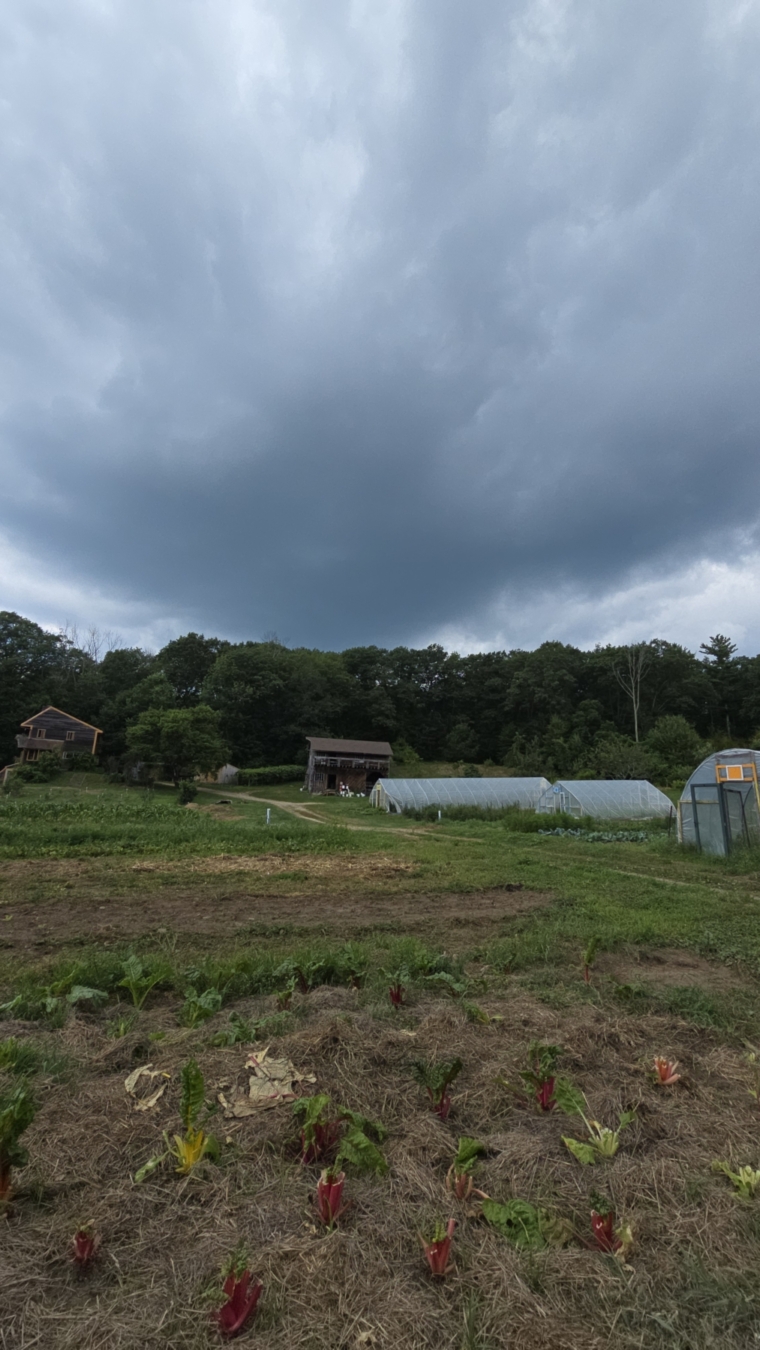
The storm so close but so far away
Quick Links
Buy Meat
2025 CSA Order Form
Contact Julie
Products Available Now at the Farm
Become a working shareholder
Donate to the MHSC
Workshops
Buy J and J’s book
Many Hands Make a Farm
https://www.chelseagreen.com/
Leave a Reply
You must be logged in to post a comment.