March 23, 2026
Truckers and Other Delivery People
|
|
|
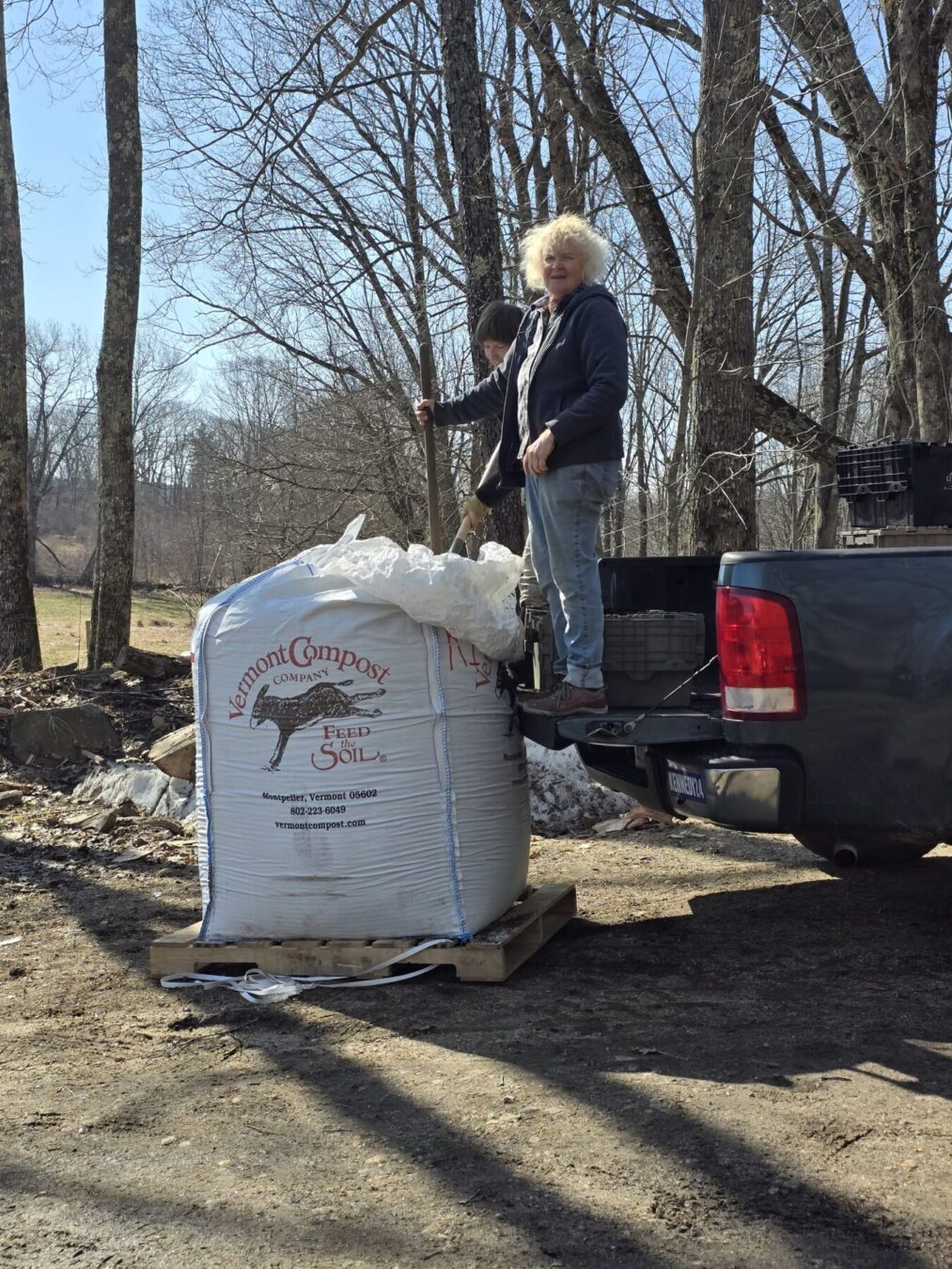
On Friday, Ross Trucking showed up with our annual tote of VT Compost Potting Soil. As Marissa and Clare and I stood waiting in the driveway for Big Dog to show up with the load, I dropped back into a muse state around the 35 or so years that we ran the NOFA bulk order at our farm from around 1985 – 2020. The community that developed around that singular spring activity is a story for another day, but I would like to focus on the truckers today.
As a population in this country, we count on truckers for a large percentage of the consumables that make our businesses, institutions and homes function from day to day. From the big trucks – 20-53’ tractor trailers – that bring large and heavy items to facilitate the operation of our farm to the delivery trucks and vans that bring us the smaller items that we buy for the functioning of our household, it came home to me yesterday how much we count on these folks for our comfort and sustainability.
Back to the bulk order (a mid to late March event historically), the truckers were often coming down our very narrow Sheldon Road in its gravel/mud state in the late 20th century, and barely getting in or out. It has dawned on me that truckers are often operating in very risky, unsafe and/or tight spaces with these monster vehicles. And they are often making a long-haul and lonely trip. Sometimes they would show up in the middle of the night and park their big rigs in our driveway, which wasn’t a lot longer than their trucks.
Today is a shout out to this part of our society that is often an underappreciated yet essential segment. Have you thanked your delivery person today?
|
|
|
|
|
|
|
We weren’t expecting the VT Compost until today, but Big Dog (as he introduced himself to us when he arrived) called on Friday morning to see if we would like to get our delivery early, as they had already received it at the trucking depot. We arranged for him to show up in about 45 minutes from the phone call and I asked him to text me when he was 10 minutes out so that a handful of us could break off from our mushroom log cutting in the woods, and be in the driveway when he arrived, which he did.
I have to say that sometimes truckers are monosyllabic and irascible when they show up, but he came down Sheldon Road with that familiar sound of air brakes and met me at the end of the driveway, a smile on his face. I showed him exactly where we would like the very large and tall tote dropped, and he proceeded to back into the driveway and then use his hand operated pallet jack to lower it to the ground into the exact location that I had requested. Thank you, Big Dog, and Ross Trucking, for making this moment in our workday a special one.
|
|
|
|
|
|
|
Do We Need Males?
by Jack Kittredge
If there is one thing which biologists are pretty agreed upon it is that, while asexual reproduction is relatively common among plants and bacteria, sexual reproduction among vertebrate animals is necessary to prevent species degradation over time. Without the random recombination of genes sexual reproduction provides for offspring, the process of natural selection cannot eliminate the harmful mutations which inevitably accumulate in a complex species over time. Scientists are so sure that sexual coupling is necessary for long term vertebrate success that they have computed a formula (Muller’s rachet) telling how long species which for some reason are able to reproduce by parthenogenesis (development of an embryo from an unfertilized egg) can survive.
Yet along comes a fish, the Amazon Molly (Poecilia Formosa), which appears to be the product of a long-ago cross-species mating between a female Atlantic molly (Poecillia mexicana) with a male sailfin molly (Poecillia latipinna). The new fish were all daughters (thus the species was named for the female warriors of Greek mythology) and clones of their mother. And they produce clones themselves but, unlike true parthenogenic creatures, they mate with related species — not for the genes a father could contribute but just the sperm itself, which seems to kick-start embryo development somehow.
According to Muller’s rachet the Amazon molly should only survive for about 10,000 years. These mollys, however, appear to have been around for at least 100,000 years. How have they managed to evolve and purge harmful mutations?
Recent advances in DNA reading technology suggest that the molly has indeed accumulated mutations much faster than similar sexually reproducing species, but has developed a repair mechanism by which one version of a gene “overwrites” the other. While not as effective as employing sexual recombination, the molly’s method allows some diversity to develop by retaining useful mutations and has bought the fish more time.
Is there a message in all this? Probably only that life is incredibly inventive and anyone who attempts to apply rules has limited thinking. These laws are often useful and suggest ways forward, but ultimately nature flows through many channels and will find a way to assert herself.
And men? When not contributing genes it’s never a bad idea to check around and see if you are still being useful.
|
|
|
|
|
|
|
Marj and I spent a few hours between us figuring out how to dismantle the CSA ordering process on the website and Marj put it together again so that ordering on line is now very smooth, and hopefully hassle free, with the capability to pay with Paypal, a credit card, SNAP, or to download a form and accompany it with a check sent to the farm. Try it and see!
Meanwhile this week we also located a replacement for our previous Shrewsbury pickup site. It will be at the home of Maria in Auburn and she and Janina will share the delivery.
Here is a little plug for our Auburn site
|
|
|
|
|
|
|
Thanks to Sally and Mara who signed up this week.
Reason number 9 to join the MHOF CSA
When you join the MHOF CSA, you are buying a product that comes with 45 years of experience on this plot of land. You are supporting farm viability and getting the benefit of 4 ½ decades of farming experience.
|
|
|
|
|
|
|
|
|
|
|
|
|
|
Many Hands Sustainability Center
|
|
|
|
|
|
|
|
|
|
2026 Farm Workshop Schedule
|
|
|
|
|
|
|
|
|
|
|
|
|
|
Information of interest from the outside world
|
|
|
|
|
|
|
|
An Annual Homesteader’s Preservation Calendar
|
|
|
Greens – in this category, we can easily group a number of leafy vegetables – spinach, Asian greens, chard, kale, collards, cabbage, and others. Because I believe that greens are so important to our health and well-being, and because we raise so many of them and provide them for our CSA and other markets, I will do a quickie on preservation of these items this week and go into greater detail over subsequent weeks regarding each one.
All of these greens are handled generally the same way. For freezing, I chop them into bite size pieces after washing them and removing any detritus, cores in the case of cabbage, and some of the stems of kale and collards to make the ratio of green to stem more palatable.
Bring a pot of water to a boil and immerse the chopped vegetable into the water. When it comes back to a boil, simmer it for one – two minutes only. Pour the contents out into a colander in the sink and douse with cold water from the tap, “fluffing” with your fingers for a quick as possible cooling. Pack in your favorite freezer container.
In 2026 Jack and I am going to go on a deep dive into packaging for freezing vegetables, applesauce, etc. (all the things that we have been freezing in plastic bags or containers). My goal is to move away from plastic, for all the usual reasons. If anyone has any resource material on this, please share.
You can watch these videos that we made for youtube a few years back –
|
|
|
|
|
|
|
|
|
|
|
Golden Digestive Egg Drop Nourish Bowl
Jennifer’s Recipe
|
|
|
|
|
|
|
|
|
|
|
|
|
|
|
|
|
Bionutrient Food Association Conference Week 10
The Brixit Campaign
|
|
|
|
|
|
|
|
|
Life gets more and more fun as we move slowly into spring. Yes, the weather is usually kind of rainy, sometimes with a little snow, often with some March winds, and every once in a while we get a beautiful day like Friday. So, we take what we can get, enjoy the fact that we are no longer trudging through the snow, and are working closer and closer to the day that we will be planting something in the soil in the open fields. But not yet!
On Monday the chicken house crew made huge progress on one of our new pasture houses, and after lunch the brain trust went out and finalized plans for how we can attach a little shed roof for the dogs to go under on a rainy night when they are on guard duty. More later
|
|
|
|
|
Stu, Danny and Jack make plans
|
|
|
We accomplished the annual move of our liquid fertility from the basement to the barn tractor bay. Everything is counted and in alphabetical order to make it possible for our team to easily access the components of our foliar mixes.
|
|
|
|
|
Another accomplishment of Monday was the weeding and subsequent mulching with woodchips of the Clare and blue houses.
|
|
|
|
|
Angie, Paula and Devra in the weeding process
|
|
|
On Friday we were able to cut half of our logs for mushroom plugging before the chainsaw gave out.
|
|
|
|
|
Matt takes down a yellow birch
|
|
|
We then went to the mushroom yard where we sorted out old logs and reorganized the ones we will keep.
|
|
|
|
|
Amanda, our chief cleaner and organized washed up a bunch of our nut storage jars and relabeled them. A satisfying job for a householder!
|
|
|
|
|
Marissa and I packaged up a bunch of our new potting soil into our plastic flip tops so that we have lots of potting soil at the ready. We started cabbage, lettuce and artichokes.
|
|
|
|
|
|
|
Then we were able to finally return to fruit tree pruning and accomplished 5 or 6 trees. Only about 25 to go.
|
|
|
|
|
Clare prunes a peach tree
|
|
|
|
|
|
|
Marj shares expertise with Clare for better facility in filling out our certification files
|
|
|