Friday we picked up on a fertility sequence that has been a focus of mine since last summer. The “back of the north”, a section of the farm that is about 7200 square feet in area, is a section bounded by the orange hoophouse on the west and the back of the field melting quickly into the woods. It is hidden from the rest of the home fields by the orange house, is colder due to its location, and is often wetter than many parts of the farm. Last spring we planted kale, collards and broccoli, and mulched it early. But regardless, in the spring flooding of this field we ended up with excessive grass. I tried unsuccessfully to keep it weeded and finally gave up, letting it grow lushly until early September when we mowed it, sprayed it heavily with a combination of AEA rejuvenate (https://advancingecoag.com/product/rejuvenate-gal-p68500760/?accordion=3 ) and SeaShield (https://advancingecoag.com/product/seashield-gal-p6850087/?accordion=0 ), tarped it and let it sit until November when we took the tarps off, and ran the turkeys through it for a couple of weeks in their pasture houses. After the snow melted a week ago we found some really nice-looking soil with a fair amount of residue, some attached, but mostly decaying.
Friday Clare and Marissa taught Amanda and Angie how to mix amendments, again some Rejuvenate, SeaShield, and a biological inoculant, and get them into a backpack sprayer and spread on the field. Meanwhile Clare and Marisa and I did some spot hoeing. At the end we spread some of Green Cover Seed’s cool season soil builder cover crop seed mix (https://store.greencover.com/products/cool-season-soil-builder).
Our plan is to let the cover crops grow until early June when we will come through, mow the whole area, then cut a strip with our hoes for planting winter squash plants, and then mulch them heavily in the strip. At this juncture, the long-term soil building strategy, the infusion of lots of different soil biology connected to the 11 different species of cover crops, the fertility brought by the turkeys last fall, and the heavy hay mulch that we will use should produce a beautiful winter squash crop while breaking the grass cycle that got ahead of us last season.
This is what I most love about farming, the ability it provides us to turn a fiasco into a learning experience. I will keep you up-to-date on our progress.
|
|
|
|
|
|
|
Maria Leo first became known to me back in 2020 when she picked up her NOFA bulk order at the farm, and stopped in to say hi. She took off her mask and we sat on the couch and became instant friends. Ever since then she has been an off and on working shareholder. It turns out that she is a high-level shoe designer for her day job, and sometimes can arrange to sneak out of work to volunteer with us. She calls me Miss Julie and thanks me profusely each week for the opportunity to work on our “wonderful farm.” I ran into her at the NOFA conference a month ago and she excitedly explained that she could host the CSA site to replace Leslie, who did such an outstanding job in Shrewsbury.
I am constantly reminded that the only way this place runs is with the extra investment of so many disparate people who call it their home away from home, those who donate, those who buy, and those who do the work here. Thank you, Maria, for always putting a smile on my face.
|
|
|
|
|
Home-Cooked Meals and Dementia Risk
by Jack Kittredge
If Julie’s earnest reasons why patronizing our farm will put a smile on your face have not persuaded you, how about this: A new study of over 10,000 Japanese followed for 6 years found that home cooking at least one night a week was associated with a 30% reduction in dementia risk.
“What?” you might ask. “What is the connection? And who says so?”
The second question is the easiest to answer. The 7-page study, just published here in the Journal of Epidemiology and Public Health, was conducted by three scientists, two from Tokyo’s Institute of Science’s Department of Public Health. The third works for Preventive Medical Sciences at Chiba University in Chiba, Japan.
The study authors noted the fact that dementia is emotionally and financially very costly, is increasing in prevalence, and that some older people who often live alone have “no one to cook for” and come to rely on restaurants and takeaway foods for many of their meals. They decided to examine the connection between that practice and the eventual development of dementia.
They had access to a 10,978 person 6-year gerontological database, among whom 11% of participants suffered from dementia. The database, compiled by the Japanese public long-term care insurance system, had baseline information assessing the participants’ cognitive backgrounds, including cooking frequency and skills. The authors divided participants into high frequency and low frequency cooking cohorts and discovered the dementia risk reduction for the high frequency group.
The first question: “But what connects home-cooking to dementia prevention?” is still a matter of some investigation.
The study suggests that meal preparation has been shown to improve diet, employ cognitive skills and promote exercise, all of which impact senility risk. Diet effects are due to increased vegetables and fruit, decreased ultra-processed food, and lower consumption of sugary and alcoholic beverages, among other factors. Cognitive skills include meal planning, selecting and acquiring ingredients — considering freshness, cost and diversity — choosing cooking procedures and serving the meal. Exercise involves going to the market, preparing the repast, and cleaning up.
While the 30% reduction in dementia risk applied generally, a more detailed look at the data reveals that the reduction is even higher for individuals who had limited earlier experience with cooking, i.e. novice cooks. This may be because the learning gap is larger and more challenging for them.
Almost everyone these days knows a family member or friend who is senile. The loss is tragic and in some ways worse than death itself, lingering but irreversibly downward. Perhaps the growing number now of elders is making dementia more evident, perhaps our increasingly toxic and radiative environment contributes, perhaps our avoidance of simple physical labor is partly to blame. But our food, which has become heavily processed, chemicalized, and packaged, is also suspect. That is something we can help with here.
#110 From Toxic Fields to Organic Farms with Jack Kittredge
(to listen to Jack click on play and drag bar on bottom of screen to 15:35)
https://hellog4k.podbean.com/e/the-title-of-episode_110_toxic_fields_organic_farming9g51r/
|
|
|
|
|
|
|
Reason number 10 to join the MHOF CSA
When you join the MHOF CSA you will become connected to the farming year, week after week, and learn vicariously all the details of what goes into producing high quality food. You will learn about seasonality and what it means to truly eat “in season.”
We do keep you weekly informed about what we are up to through this newsletter and our various social media platforms. And if you would like to see first hand what we are up to, we love to have visitors during farm time. Come and talk as you follow us around, and stay for lunch. We love getting to know you.
We were very happy this week to receive some new (and former) CSA members. Thank you Sherry, Forest Otter, Jodie, Rachel, Alan, and Isabella for joining the CSA! Only 2 months until launch!
|
|
|
|
|
|
|
|
|
|
|
|
|
Working shareholders
Okay, I know there are a few of you out there just dying to become a working shareholder at MHOF, because we have so much fun, get lots of exercise, meet new folks, eat well, and also end up with a lot of food in exchange for the work. But for some reason you haven’t made that call yet. Take the leap. We need folks of all stripes to keep this engine running. All I ask is that you hustle. Everything else will fall into place nicely. Reach out to grab a slot on a M, T, W, F from 8:00 – 12 (breakfast right now at 7:30, 6:30 come June) and lunch at noon, if you are so inclined. Saturday working shareholders work from 7-10 with breakfast at 7 included. Julie@mhof.net; 978-257-1192.
|
|
|
|
|
Eggs
Today our chickens end their winter vacation free ranging all over the farm and go into their chicken tractors, which we move around our pastures from April – November. They tolerate this because we keep low stocking numbers and move their houses 5 days per week. We bring them their certified organic grain and oyster shell and they do the rest by foraging in their 80 sq. ft pens for the all-you-can-eat buffet.
I can safely put our eggs up against any that are out there on the market for flavor and health-giving benefits. They cost $10/dozen. When you pay this price you are supporting a top-of-the-line chicken lifestyle that reaps benefits for them and for the consumer of their eggs.
Lately I have been reading about the extreme importance of choline in building and maintaining an eater’s strong vagus nerve at any age, and for building the brain from conception in the human fetus. After beef liver, eggs are the best natural source of choline. So, enjoy them.
You can stop by the farm and buy eggs (by appointment) or order them as an add-on to your CSA share.
|
|
|
|
|
|
|
|
Many Hands Sustainability Center
|
|
|
Jack and Marj and I worked a few hours to improve the functionality of the MHSC website and presentation this week, and we are quite happy with how it has turned out. Take a tour around the site – https://mhof.net/many-hands-sustainability-center/.
We are in the middle of our 2 for 1 challenge for the food access portion of our work. We have raised a total of $936 toward the $2,000 needed to collect on a match from a generous donor. Thanks to Sherry and Forest Otter and William this week.
And Jennifer has taken on the job of outreaching to school and community groups to invite them to come and volunteer and learn for a day.
https://secure.givelively.org/donate/many-hands-sustainability-center-inc/food-access
|
|
|
|
|
|
|
|
2026 Farm Workshop Schedule
|
|
|
Marj has posted all 7 of our on-farm workshops on the MHSC site. You can register at this link – https://mhof.net/events-workshops/
At our mushroom plugging workshop our farm experts will teach through doing how to plug logs for shiitake, chestnut, lions mane and oyster mushrooms. Each participant takes home a plugged log at the end of the day. It runs 10-12 with a pot luck lunch at the end.
Register for this workshop here – https://www.zeffy.com/en-US/ticketing/mushroom-plugging-workshop
|
|
|
|
|
|
|
|
Information of interest from the outside world
|
|
|
Your Baby’s Metabolism is Being Decided Right Now | Jessie Inchauspé
https://www.youtube.com/watch?v=ONCtil4b6Lo
This is a very good talk hosted by Dr. Mark Hyman – a must for anyone wanting to have a baby. Don’t forget the choline!
|
|
|
|
|
|
An Annual Homesteader’s Preservation Calendar
|
|
|
From our readers –
Blanching
“But mostly, I’m writing to share a blanching technique that you might appreciate. There are these large pasta pots that enable you to lift your boiled or steamed or whatever food up out of the pot without throwing out the water. So if you blanch your greens in one of these, and lift the greens out when ready, you still have the blanching water in that large pot on your stove. You replace the insert and bring the water back to a boil (it’s still almost there) and reuse it for the next batch. The water carries the cumulative nutrients from each previous batch.
This is a great saver as you don’t have to fill your pot with fresh water each time AND, you don’t have to use extra energy (wood, gas, electricity) to bring a fresh, full pot of water to the boil. Plus, you don’t have to lift a pot full of boiling water and pour it out into a colander until the last batch. OR, even better, don’t pour it out! Use it for amazing soup or stew! Or cool it and use it to water your indoor plants.
Joanna”
Regarding freezing in other than plastic
“We here are big fans of Teddie peanut butter that comes in the glass jars. We have been using and reusing them for freezing for decades.
I do not fill the jars to the tippety top, and I do not screw the caps on super tight…..other than that they are very usable and reusable for soups, veggies, meals, pear sauce for Ian’s meds, etc
Peace to your heart and pass it along G”
“Hi Julie and Jack,
I have upgraded to glass for freezing liquid items. My research recommended using straight sided glass mason jars to prevent breakage in the freezer.
Leslie”
Spinach
In a class of vegetables – greens – that so many people turn their noses up about, spinach for some reason is a standout as something to be eaten. When I think back to growing up and watching Popeye the Sailor and his love for spinach, I suspect someone was trying to push the value of spinach to a population that was otherwise non-compliant in its consumption. Whether it was Popeye or another influence, folks like it now. And a wise vegetable grower will raise as much spinach as they can for sale.
I found a great article that I will link here from Cleveland Clinic – 7 Reasons You Should Eat More Spinach – https://health.clevelandclinic.org/benefits-of-spinach
Their 7 reasons are that it offers a low-fat, low-calorie source of nutrients, protects against disease, lowers blood pressure, boosts brain health, improves gut health, supports healthy blood and protects eyesight.
It is so easy to preserve. I wash it, blanch it for only one minute, cool quickly in cold water, squeeze out the extra water, and package it for freezing. It is best grown in the early spring and late summer to fall, and also does well in the hoophouse.
|
|
|
|
|
|
|
Roasted Beets with Ginger and Bacon
Marj’s Recipe
Ingredients:
Beets – 1 pound, trimmed and scrubbed
Rosemary – 3 sprigs
Olive Oil – 5 tablespoons extra-virgin olive oil
Bacon – ½ pound thick-cut smoked bacon, chopped
Onion – 1 large yellow onion, diced
Fennel – 1 large fennel bulb (about 1 pound), cored and finely chopped
Garlic – 4 garlic cloves, smashed and finely chopped
Ginger – ¼ cup finely chopped fresh ginger
Pantry/Seasoning:
Salt and freshly ground black pepper
1 tablespoon agave nectar (optional)
1 tablespoon Dijon mustard
2 tablespoons cider vinegar
Garnish/Serving: (optional)
¼ cup chopped flat-leaf parsley
1 bunch (about ½ pound) watercress, tough stems removed
Grated zest and juice of 2 lemons
Instructions:
Roast the Beets: Preheat your oven to 450°F. Place the beets and rosemary in the center of a large piece of foil. Drizzle with 2 tablespoons of olive oil and season with salt and pepper. Fold the foil to create a sealed packet, place it on a baking sheet, and roast for about 1 hour until tender.
Prep the Beets: Once cool enough to handle, rub the skins off with a clean towel and cut the beets into ½-inch cubes.
Cook the Bacon Base: In a large skillet, heat the remaining 3 tablespoons of olive oil over medium-high heat. Add the bacon and cook until it begins to brown (2 to 3 minutes). Add the onion, fennel, garlic, ginger, agave, and mustard. Cook until the onion is translucent and the fennel has softened (2 to 3 minutes).
Combine: Carefully drain the fat from the skillet. Stir in the vinegar and parsley, then season with salt and pepper. Transfer this mixture to a large bowl and toss well with the roasted beet cubes.
Serve: Spread the watercress leaves on a platter, sprinkle with the lemon zest and juice, and top with the beet mixture.
It’s also excellent paired with some risotto and ginger soda or libations! *chef’s kiss*
|
|
|
|
|
|
|
Bionutrient Food Association Conference Week 11
BALANCE – Week Eleven deepens the integrating arc by holding multiple truths at once: productivity and ecology, profitability and responsibility, measurement and meaning. Together, Nigel Sharp and Kym Kruse offer a vision of agriculture rooted not in trade-offs, but in alignment — where healthy soil, healthy businesses, and healthy communities reinforce one another rather than compete.
|
|
|
|
|
|
|
|
|
No one reminded me that with spring comes a lot of heavy lifting! Monday was spent collecting all of our dry minerals from the garage and 2nd floor of the barn, mixing them and spreading them on all of the fields. We put down Epsom salts, gypsum, boron, manganese, copper, and potassium sulfate on all of our fields. Thanks to Brandon, Tyler, Gary, Devra, and Clare for making this happen in a rather timely fashion.
|
|
|
|
|
|
|
Mixing and spreading minerals
|
|
|
This while Stu and Matt worked on getting our 3 chicken layer houses ready for the April 1 incarceration of the chickens in their field houses.
Dave came over to give us all sorts of bad news about the necessary repairs needed for our Ford 2120 and our chainsaws. Must be spring!
|
|
|
|
|
The afternoon was spent on tall ladders where Clare and Devra and I pruned another row of fruit trees. At the end of the day I was reminded by my level of fatigue that I am almost 73 years old!
Friday started out by moving all of our back porch paraphernalia to the front porch in preparation for son Chuk spending this entire week putting in new windows on the porch, while also building more functional shelving and paneling the walls. It is an exciting project.
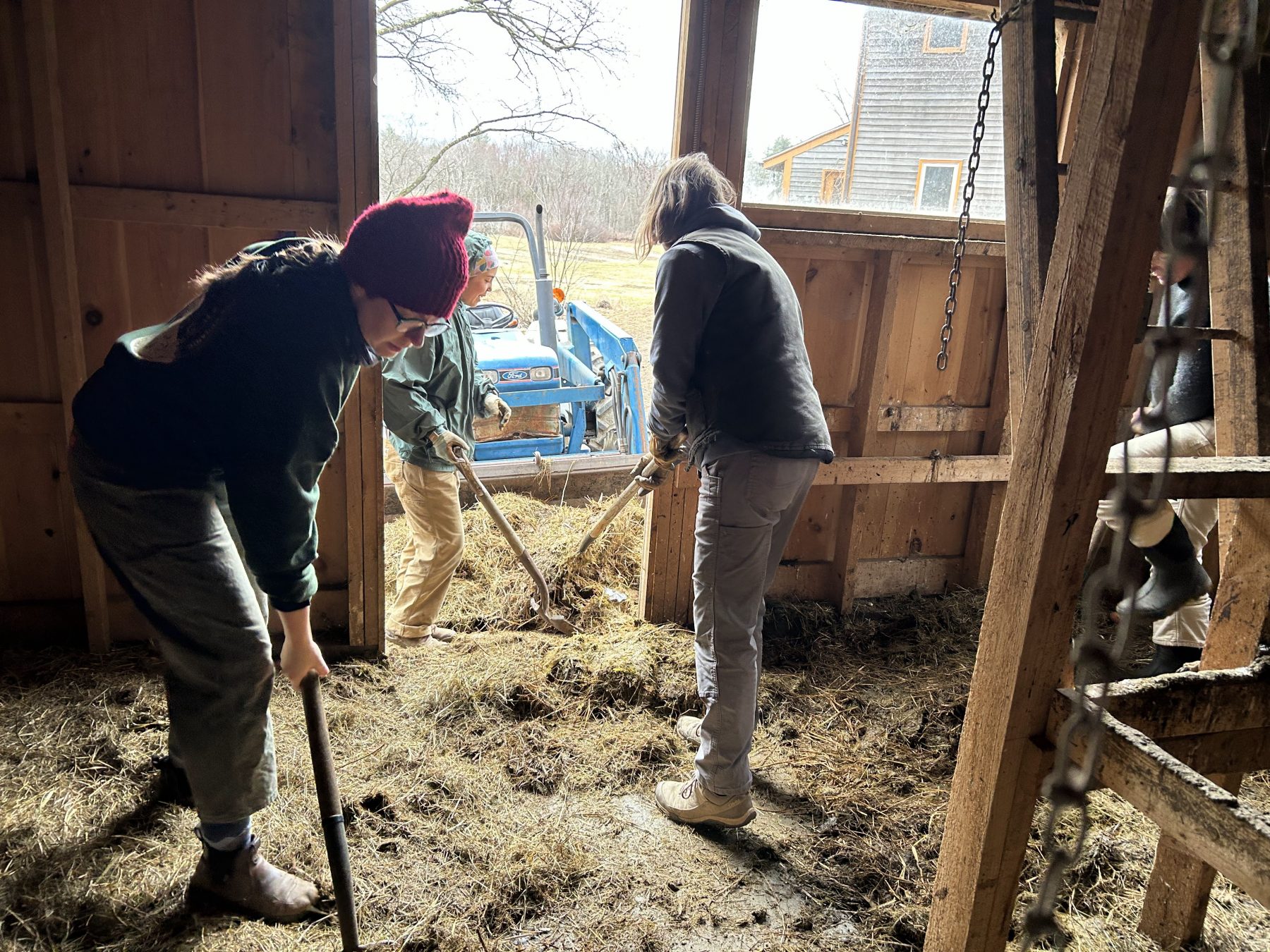
We then moved on to the “clean the chicken house a few loads of s..t at a time” project. Every year, cleaning out the winter’s stores of fantastic hay and chicken manure bedding breaks a few of our backs. So we are doing it in stages. I was reminded how lucky I am that not one (Marissa), but two (Angie) experienced goatherds have found their way over here. Damn, can they both lift a mean pitchfork!
|
|
|
|
|
Amanda and I picked the final crop of tatsoi from our October planting in the Clare house while the rest of the folks started a bunch more seeds in the greenhouse.
Then we started the main event (taming the back of the north field), finishing after lunch.
|
|
|
|
|
|
|
We moved on to a fun job of pulling nails and bits of metal out of the burn pile,
|
|
|
|
|
and then cleaning the house and washing some windows. Thrown in there, Amanda cleaned up 8 more of our glass storage jars, and Marj made all sort of upgrades to the website, and took some marketing videos with me.
Friday lunch turned out to be a festive event. Ben Wells-Tolley, for his 45th birthday decided he wanted to take his wife Laura on a tour of fun places, and he picked ours!
They brought a lavish spread of cheese and salami from their dairy farm and it was old home week where it turned out that everyone at the table had some connection to everyone else that didn’t necessarily originate at our farm. I got to take off a few minutes in the afternoon to given them the red carpet tour of our operation while we talked incessantly of farming, childrearing, health, etc,
|
|
|
|
|
|
|
Saturday morning, I had a great chat on air with Phil George from Wellness Wave Radio, LLC out of Worcester. A treat.
|
|
|
|
|
|
|
Brandon showed up at lunch and it was his birthday. With no advance notice I was forced to serve him a “birthday potato!”
|
|
|
|
|
|
|
|
|
|
|
|
|