Tuesday night was the first thunderstorm of the season, followed by another on Wednesday night, followed by yet another on Thursday night. We finished off the week with rain off and on Friday. Because of the higher-than-normal heat last week, they seemed almost like June storms. And the results were as beautiful as I remember them from summers past. The soil, which has been a little on the dry side for this time of year, soaked up this special “electric” rain avidly. The grass has grown tremendously, along with the spring flowers. The shiitake logs sprung forth with sumptuous mushrooms that we feasted on immediately in our scrambled eggs. The season is upon us, and we have the fatigue at the end of a day of raking hoeing, pruning, and tarping to show for it. Basking in the windy and sunny days, however, imparts a special vibrancy of spirit and body, as our bodies start to tan and our muscles harden. And the couch at 3 pm has a special call to me once we have finished our farm day. Nothing like an afternoon nap to reset the clock for the less challenging evening tasks to follow. May we continue to be so fortunate to receive the rain!
|
|
|
|
|
|
|
|
|
|
|
As Jack and I study the geography and history of the Middle East in order to better understand the forces at play in the Iran war, one of the things that comes home to us is the lack of water resources that so impacts life in that region of the world. I have always truly appreciated that we get somewhere between 40-50” of annual rain here in our corner of Massachusetts, but as I start to more viscerally appreciate what so much of the world has to deal with in terms of water scarcity, I find myself extremely grateful that we have water, and rain, and an ecosystem that can naturally recharge itself and refill our underground aquifers. It inspires me to be daily grateful for this abundant resource that makes it so relatively easy to raise nutritious food on our land.
|
|
|
|
|
|
|
Animals Hostilities
by Jack Kittredge
Animals in nature certainly compete and show rivalries, but I was under the impression that any violence that results is usually between two individuals, not groups, and is resolved, after a struggle, by shows of dominance and submission, not killing. Researchers studying chimpanzees (our closest relatives), however, have published a disturbing paper in the April 9 issue of Science.
In 1995 scientists began a long term study of chimp behavior in Ngogo, a wooded area of Kibale National Park in Uganda. There was plenty of food and the community grew to over 200 individuals. They lived mostly in two nearby areas, Central and Western, but mingled and mated peacefully throughout Ngogo.
On a June day in 2015 chimps from the two groups met, however, and the Central ones chased the Western ones away. After that they avoided each other and mating between the groups ceased. Western males started patrolling the Central territory and in 2017 attacked and wounded its alpha male. Since then they have killed 7 Central adults and 17 infants. Although the Central group is larger, no record exists of them ganging up to kill in response.
What might account for this anomalous behavior?
Scientists are puzzled: perhaps leadership? One primatologist cites that there were unusual deaths in 2014, by natural causes, of five adult males. “Some of these adult males were important connectors”, he says.
Some blame the chimps’ very own success. “The group continued to grow and grow and grow, and it reached the size that individuals couldn’t pull together anymore” says another primatologist.
Or perhaps it was reproductive friction, being cut off from the other group’s females and deciding: “maybe now’s the time to try to do something about that.”
And then how do you explain the Central group’s failure to escalate and kill as the Western one did?
So far as we know, chimps aren’t divided by religion, language, politics or ethnicity. “You do not need ideology to generate hostilities”, though, says a Harvard professor, “The motivations for warfare are much more concerned with our biology”.
If so, and if Chimps are our closest ancestors, probably some of that biology is still in us. But does it have to rule? Can we learn to resist the distractions offered by expansion, covetousness, and anger? Can we find the connectors among us who will be good leaders?
|
|
|
|
|
|
|
We are still recruiting madly for the CSA
This week we discuss all of the wonderful lettuce that CSA members will receive this week. Thanks to Kay and her daughter and Martha and Claudia for four more shares this week!
|
|
|
|
|
|
|
|
|
|
|
|
|
|
|
New purchasing opportunity
This year we have decided to institute a new opportunity for folks to buy at the farm. It will center around produce that we have in ample quantities any given week, which might include foods in quantity for food preservation as the season progresses. On Friday evenings from 3-6 pm you can come by and pick up items that are put on the list in this newsletter. Ordering deadline will be each Wednesday at midnight via this form. You can pay by cash, check, SNAP, or Venmo.
The first crop that we have in excess each year is our chives. These spring alliums are pudgy and brimming with life. By mid-April, all of my stored onions are gone and I have a strong hankering for these very tasty alliums. I use them in soup, salad, egg dishes and garnishes for anything. An ample bunch will cost $3.00. We also have some over-wintered cilantro at $3.00. This Friday, April 24 we will also have eggs, many cuts of pork, and our soaps, salves and tinctures.
|
|
|
|
|
Additionally, I will be starting an email list that will go out directly to those who sign up. You will receive it early Monday morning each week. Email me at Julie@mhof.net to be put on the list
|
|
|
|
Many Hands Sustainability Center
|
|
|
|
|
|
|
Your donations help not only fund organic eggs and produce for the Worcester Woo Fridges and Barre Food Pantry, but also help support hiring kids from Stetson School who have demonstrated the maturity needed to hold a job, perhaps their first jobs.
You can donate here https://mhof.net/many-hands-sustainability-center/
Or send a check to MHSC to 411 Sheldon Road, Barre, MA 01005.
|
|
|
|
|
If you belong to a community group, are a professor at a local college, or have any bunch of people who would like to spend a day or a half day on the farm, reach out to us. We would love to host you.
|
|
|
|
|
|
|
|
|
|
2026 Farm Workshop Schedule
|
|
|
Marj has posted all 7 of our on-farm workshops on the MHSC site. You can register at this link – https://mhof.net/events-workshops/
At our mushroom plugging workshop our farm experts will teach through doing how to plug logs for shiitake, chestnut, lion’s mane and oyster mushrooms. Each participant takes home a plugged log at the end of the day. It runs 10-12 with a pot luck lunch at the end.
Register for this workshop here –
https://www.zeffy.com/en-US/ticketing/mushroom-plugging-workshop
|
|
|
|
|
|
|
|
|
|
|
Warm Kale & Radish Salad with Spiced Chicken & Lemon Tahini Drizzle
Jennifer’s Recipe
|
|
|
A warm, nourishing kale and radish salad topped with gently spiced chicken and finished with a bright lemon tahini ginger drizzle. Roasted roots bring natural sweetness, while sprouts and fresh dill add lightness and prana—creating a balanced, digestion-supportive spring meal.
|
|
|
|
|
|
|
|
An Annual Homesteader’s Preservation Calendar
|
|
|
Kale and Collards
We raise a lot of kale and collards here at MHOF. And I have grown particularly fond of collards. Here is a quick article with 11 reasons to eat collards – https://naturalfoodseries.com/11-health-benefits-collard-greens/ And did you know that collards were once considered the state vegetable in Georgia?
Here also is an article about kale – https://naturalfoodseries.com/13-health-benefits-kale/
Both of these foods are monsters when it comes to how they improve your diet and health – they both serve to detoxify the body, fight cancer, strengthen bone, support digestion, prevent anemia, lower cholesterol, support hair growth, slow down aging, manage diabetes, and improve mood.
I make sure that we eat collards and kale every day of the year. In the morning we have them in eggs. I do a quick thaw on individual frozen packages of kale, collards, chard, peppers, broccoli, cauliflower, sugar snaps, parsley and what have you, and chop them all fine. Next I remix them into a big bowl, and then parcel them out into 2 cup packages of mixed vegetables and refreeze them for use each day. I start by frying an onion or chives in season in avocado oil, throw in a package or two of the mixed vegetables (depending on how many are eating), sauté quickly and then mix in enough beaten eggs. I steam it all with a tight-fitting lid and serve.
There is another way that we boost our kale and/or collard intake each day. Once we have prepared them for freezing (see the paragraph below), we run them through the food processor with a bit of water, and then through the Vitamix to turn them into a puree. We freeze these vegetables in pint sized containers. Every day when I make our smoothie, I dip out a T each for me and Jack and add it to the smoothie. There can be a question about digestibility of these two vegetables in the raw form, so with lightly cooking them, there is no worry about that potential concern.
To preserve kale and collards, cut them into bite-sized pieces, blanche in boiling water for one to one and a half minutes, and cool quickly in cold water, squeeze out, and package for the freezer.
I was musing as I wrote this about the fact that I have not worn make-up since my brief foray with it when I was 14 or 15. I have to say that it has been my experience that one has a flush of health in the face when you consume these super greens on a daily basis that obviates the desire for face painting!
|
|
|
|
|
|
|
|
|
|
|
Some like it hot! And so it was all week, but not to fear, it is supposed to be back down to 26 degrees by tomorrow night. Meanwhile we did make hay while the sun shone, as they say.
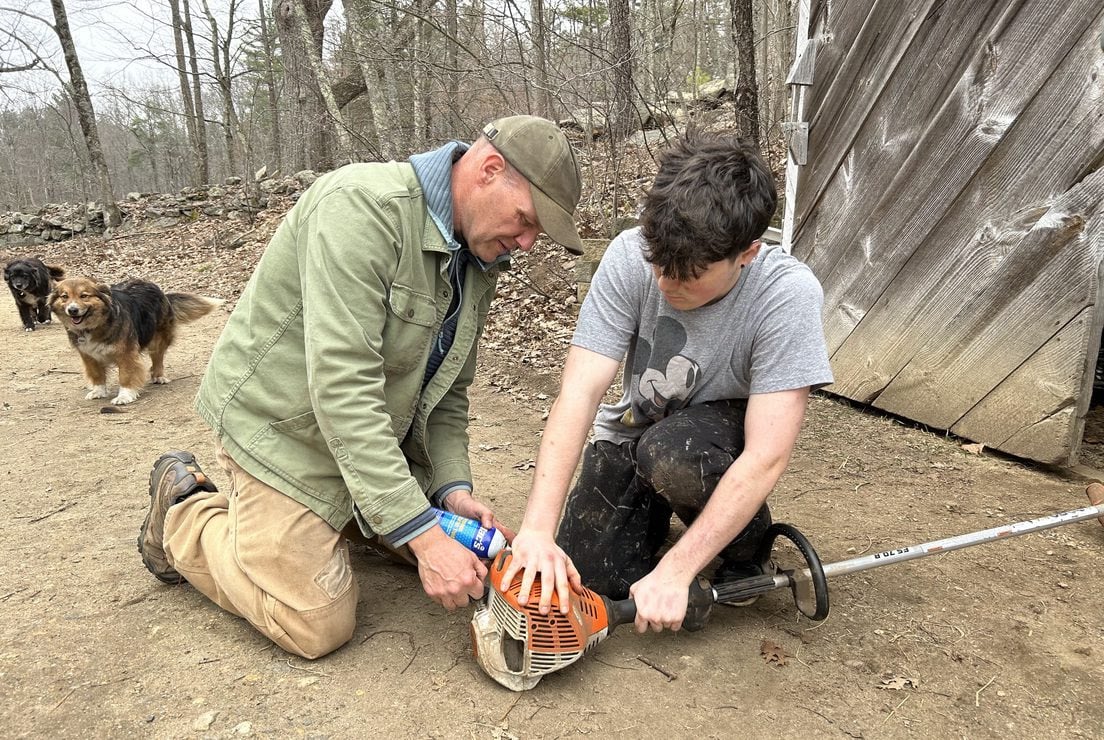
Monday, we broke into 4 groups. Stu and Lucas worked on chicken tractors,
|
|
|
|
|
Brandon and Jim cut up a tree that a beaver had felled by the pond, and also made stakes for our planting beds. The girls (Clare, Marcia, Jennifer, Laurie and I) worked with Jack doing grape pruning, weeding of blueberries in the annex,
|
|
|
|
|
taking a few more loads of chicken bedding out of the winter house and spreading it around our juneberries and gooseberries,
|
|
|
|
|
re-tarping the south field, and organizing bags and such in the barn. Marcia is back and we are so happy. Matt and Trey sorted fence posts and welded wire for future bean trellis building, and worked on getting our machines in good order for the season. On Tuesday, Jack, Marj, Clare, Angie, and Marissa pruned several grapes,
|
|
|
|
|
Clare and I almost finished mulching the fruit trees in the pond orchard in the afternoon and were happy to call it a wrap by Tuesday afternoon.
On Tuesday, Clare C-O (we ended up calling her Shorty to keep the Clares from getting mixed up), came as our TOPP mentee. The Clares and Marissa and Marj and I knocked out 23 trays of new seedling starts – leeks, cauliflower, lettuce, Brussels sprouts – tarped the west field, and then worked with Jack again in the annex. Jack and Shorty finished pruning the grapes,
|
|
|
|
|
while we other three weeded the rest of the blueberries, pruned them, brought many loads of chips up and spread them, pruned and weeded the aronia, and started the hoeing around the grape’s trellises.
|
|
|
|
|
Wednesday was still hot, but no one was complaining, and Marissa and Clare and I weeded and replanted in the hoophouses after Marissa and Drew did a soil primer ground spray on all of the fruit trees and bushes. Marissa and Jack then worked on the hardy kiwi pruning
|
|
|
|
|
and Clare got us all prepped for the arrival of the 17 Clark students and our friend Morgan Ruelle, their prof, in the afternoon. Jack took them in three groups to talk about food security and appropriate building design, while Clare and I worked with the rest of the folks to prep and plant two 400 square foot beds of spinach and 3 one-hundred-foot trellises of peas. What a crew!
|
|
|
|
|
|
|
Matt got our whirlygigs all fixed up and ready to go, and also got the mushroom yard all set up with an easy watering system – with mushroom harvest the next day.
|
|
|
|
|
Friday saw more hardy kiwi work, with Amanda back amongst us
|
|
|
|
|
And the planting of a bed each of lettuce and Asian greens
|
|
|
|
|
Next week – lots of planting and completion of our small fruit weeding, pruning and mulching.
Julie
|
|
|
|
|
Chuk finished the outside of the back porch by week’s end. He will take a break for a week and return then to finish the inside of the porch.
|
|
|
|
|
|
|
|
|
|
|
|
|