Balancing the macro and the micro

I went to bed on Tuesday night, April 7, not knowing if I would wake up to a cataclysm the next day. I wondered with Jack that night if I should chain the dogs out with the chickens overnight as I wouldn’t want them chained up if something horrendous happened overnight. I stopped short of calling all of our family members to let them know that we love them. I did reflect with Jack that I have always wanted to die at the same time, and thought that would be an upside of nuclear war.

But I did make sure to go to bed at my usual 8 pm because the other side of my consciousness knew that I had to be up by 4 am to manage all of the details of the work day ahead and the arrival of the farm staff by 7:30 for another day of work. Does anyone else suffer this schizophrenia of feeling the need to be at least somewhat up on the latest threats and atrocities in the world while conducting a busy life as normal? It does seem that the only sane path forward is to compartmentalize the war, stay informed, consider what we as individuals and in community can do to impact the macro, and then simultaneously go about our local, micro lives each day doing what we do best on this level.

Expressing Gratitude

April

April is my birth month, but I used to feel that this month was “wasted” with mini snow storms, low 30’s and fog or mist or rain, sometimes blasts of cold air, and all the shenanigans that April can pull in New England. There are, of course, those days where it is 65 and sunny and perfect, but there is still no assurance that the next day won’t be inclement again.

A couple of days ago I realized that I have come to love April, for all of its inconsistency, while it very steadily marches toward more light, greener grass, the arrival and crescendo of the peepers, leading to the decrescendo as they turn into little frogs, the planting of the peas, spinach and onion sets, the finishing up of pruning and mulching the perennials, the cleaning out of the permanent chicken house, and the rhythm of hooking up the dogs at dusk to the chicken houses and the subsequent freeing of them in the pre-dawn, always being greeted by them with jubilance.

And the people! All of a sudden people arrive out of the woodwork, to buy some pork, visit the farm, join the CSA, return as working shareholders, arrange work parties from colleges, or utilize our expertise for school environmental science classes.

As Marj said on Friday, April is a time for the promise of the year ahead, where all is still possibility. Finally I have come home to embrace all there is about April, in gratitude for its irascibleness and its potential.

Cell phone dangers?

by Jack Kittredge

Cell phones are coming under increasing challenge these days. I suppose it is to be expected that something so popular and so addictive might not be very good for us. Think sugar or gambling or tobacco.

But studies are showing problems with the clever little devices. Numerous investigations have pointed to correlations between cell phone use and tumors of the heart and brain, and reproductive health problems. Neurological impact is especially indicated.

According to one published in January, children in Sweden experienced large increases in sleep disorders since mobiles were introduced. For those aged 5 to 19 the disorders increased an incredible 17-fold. Even for those 0 to 4 years old, a 5-fold increase was reported. Causes are debated, but possibilities include nearby cell towers, particularly those which emit 5G radiation, and the blue light of screens, which disrupts hormones like melatonin that affect sleep.

The report’s lead author, Mona Nilsson, cited over 70 existing studies that electronic radiation negatively affect learning and memory. She worries, however, that public awareness of the problem is scant and “the telecommunications industry has captured most influential organizations responsible for protecting the public.”

I am put in mind of the times in my youth when similar questions were raised about such products as DDT, leaded gasoline, and tobacco. Critics were dismissed as cranks, evidence was ridiculed, scientists were hired to prove safety. Yet ultimately, sometimes through a courageous and insistent individual, people began to recognize the problem, insist on honest reporting and finally require appropriate regulation.

With cell phones we are still at that early point when we love them and don’t even want to question them. They have become so central to our lives that it is hard to actually function in daily life without one (try reserving an air BnB or validating an internet account without texting and with only a landline!)

They are truly a remarkable innovation and showcase how innovation and free markets can make life so much more convenient. It may be that rumors of inherent health problems will prove to be only the grumblings of malcontents.

But I think history says we need to look closely at such a major change in how we live and spend so much of our time — what powers it and how it impacts flesh, blood, hormones and neurons. If that is done, and we act wisely on the results, perhaps we can all sleep a little more easily.

2026 MHOF CSA

We are still recruiting madly for the CSA

This week Skippy and Harriet help me discuss the many alliums that you will find in your MHOF shares. Thanks to Kate and Alissa for joining.

Questions, call Julie at 978-257-1192 OR email julie@mhof.net

Many Hands Sustainability Center

Many thanks to Brenda and Joe and Joan who this week donated a total of $1245 toward our $2000 match challenge for our food access budget. That takes us over the top! Thanks to all who participated. And thanks to our anonymous donor who will match with $2,000 the combined donations of MHSC donors who brought it up to $2,284.

Your donations help not only fund contributed organic eggs and produce to the Worcester Woo Fridges and Barre Food Pantry, but also help support hiring kids from Stetson School who have demonstrated the maturity needed to hold a job, perhaps their first jobs.

You can donate here https://secure.givelively.org/donate/many-hands-sustainability-center-inc/food-access

Or send a check to MHSC to 411 Sheldon Road, Barre, MA 01005

2026 Farm Workshop Schedule

Marj has posted all 7 of our on-farm workshops on the MHSC site. You can register at this link – https://mhof.net/events-workshops/

At our mushroom plugging workshop our farm experts will teach through doing how to plug logs for shiitake, chestnut, lion’s mane and oyster mushrooms. Each participant takes home a plugged log at the end of the day. It runs 10-12 with a pot luck lunch at the end.

Register for this workshop here –

https://www.zeffy.com/en-US/ticketing/mushroom-plugging-workshop

An Annual Homesteader’s Preservation Calendar

Swiss Chard

Is another farm favorite, and my favorite way to serve it is sauteed lightly in avocado oil with an onion, and some shiitakes if I have them around, and then scrambled with eggs. It is also marvelous as a side dish or added at the last minute in any soup. I don’t want to brag, but we have some of the tastiest and “meatiest” Swiss chard that you will ever encounter, and it is so intensely beautiful to look at besides. Here is a great article from Cleveland Clinic on its very impressive resume. https://health.clevelandclinic.org/swiss-chard-benefits.

Sometimes chard can be bitter, and I think this bitterness is a stronger expression of its oxalic acid content (which can be a challenge for folks with kidney issues), but our chard is never bitter, and almost sweet to the taste, demonstrating its high mineral content. You can eat it raw or lightly cooked.

To preserve chard, cut it into bite-sized pieces, blanche in boiling water for one to one and a half minutes, and cool quickly in cold water, squeeze out, and package for the freezer.

Information of interest from the outside world

5 Ways to reduce plastics in your food

https://www.ewg.org/news-insights/news/2026/03/five-ways-reduce-microplastics-your-food

Link to a radio show I did with Phil George on Wellness Wave Radio

https://drive.google.com/file/d/1VEAY1JmwktSXemC-iwvyJ4v8CmDsOsMr/view?ts=69d4079d

An excellent article from staff writer Kate Meyer at Advancing Eco Agriculture, “Rethinking Soil Fertility in Market Gardens”https://advancingecoag.com/article/fertility-market-gardens/?_kx=hdiqVXU9yJz7DYb_ggaMTn_ihS9wkl5sqYkDP5bI_KQ.WdjHWJ

TOP 21 TIPS FOR TRANSFORMATION THIS SPRING SEASON

I borrowed this from daughter Ellen – good stuff – www.ellenkittredge.com

#1 – Incorporate Lemon in your diet, especially lemon zest (from grating organic lemons).

#2 – Eat more Chlorophyll in the form of dark leafy greens, seaweed, and matcha green tea.

#3 – MOVE the Body! Find a healthy movement routine for you!

#4 – Release/Process Anger: Do this in a way that’s safe for you and others around you – ask for help or support with this as needed.

#5 – Bring Gratitude to the Liver: Place your hands on it and smile into it, thanking it for all it does each day.

#6 – Eat more Beets (see recipe below for what we eat regularly during this time of year).

#7 – Choose Healthy Oils – Some of my favorite are EVOO, coconut, walnut, avocado, and sesame. Let go of all “vegetable” oils including canola, cottonseed, soy and corn.

#8 – Call on the Cruciferous family for extra healing potential: This family of veggies includes broccoli, cabbage, kale, bok choy, cauliflower, arugula, Brussel sprouts, etc.

#9 – Heal the Gut Microbiome – This is a big topic of exploration, but starting with letting go of toxic/inflammatory foods and eating a variety of healthy fruits and veggies is a great beginning.

#10 – Get Oily with Castor Oil Packs – these can be done a couple times a week. Check online for instructions or join my upcoming Spring Cleanse for some more specific guidance and support.

#11 – Turmeric for the Win! Consider how you can get more turmeric/curcumin in your diet. A turmeric latte is one of my favorite ways!

#12 – Let Go of Plastic – don’t store your food in plastic and don’t heat food in plastic to avoid taking any toxins leached from plastic into the body.

#13 – Choose Healthier Body Care Products – ewg.org is a great resource for this!

#14 – Support Healthy Detox of the Other Organs of Detox – kidneys, lymphatic system, colon.

#15 – Perfect your Protein – Choose moderate amounts and healthy sources. The liver loves protein and needs it in appropriate quantities to be able to do its essential work.

#16 – B Vitamins! Take a good supplement or get from beans, greens and many other foods.

#17 – Choline! Get it from eggs, non-gmo soy lecithin and avocados.

#18 – Skip Eating Late – Best to not eat 2-3 hours before bed (small snacks to stabilize blood sugar if needed are ok).

#19 – Add in More Fiber! Chia, flax, fruit, vegetables, beans and oats are all great additions to the diet to support a toxin flush every day.

#20 – Helpful Herbs – milk thistle, dandelion and burdock are some of the liver’s favorites.

#21 – Dry Brushing the Skin – When we help to assist the movement of toxins through the skin (which is our largest organ) it greatly helps the liver!
Farm Doins

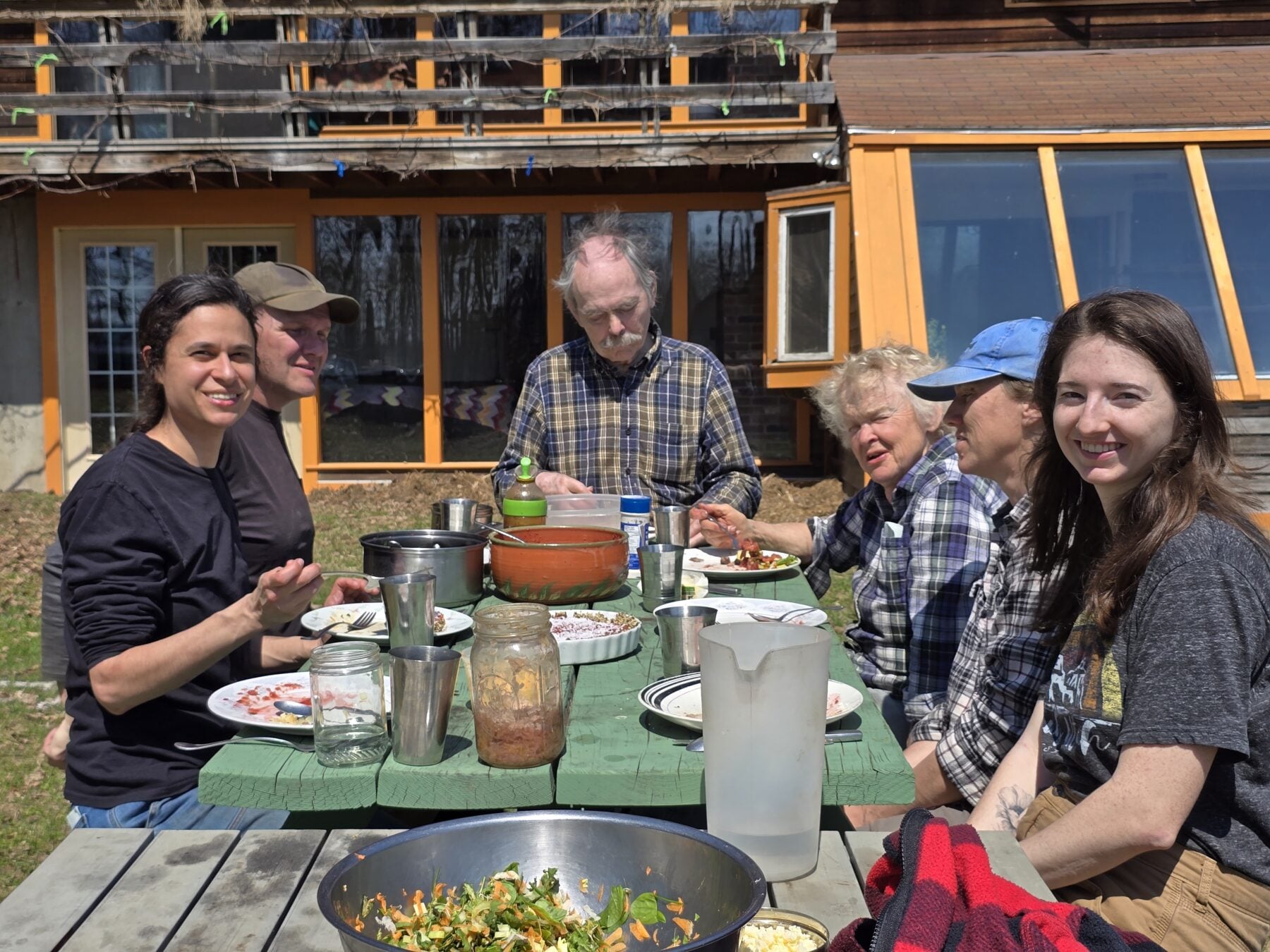
What a wonderful week we had! Jim is back and he and Matt finished up our mushroom log cutting and put up a pea fence. We were planning to plant peas on Tuesday, but moved them to this Wednesday because of those two pretty cold and snowy days mid-week.

Stu and Clay and Gary from Stetson finished our dog roofs and attached them to the chicken houses for rainy nights.

Ross worked with Clare and Jennifer (welcome back Jennifer) to spread some fertilizer and clean up the barn, plant 10 blueberries, pick up all of our fruit tree prunings and stash them in the woods, fill some holes in the yard and on the east hill of the house, and start a bunch of herbs.

On Tuesday, Jack, Marj, Clare, Angie, and Marissa pruned several grapes,

Quick Links