October 20 2025
Food Preservation
Though we start preserving food back in June with the extra strawberries, it intensifies as the summer progresses, and continues at breakneck speed through October. This week we did our first cilantro freezing, and also froze peppers, kale, collards, tatsoi, cauliflower, and broccoli. We made our first batch of pear sauce and our 4th of sauerkraut. As true homesteaders first and foremost, Jack and I have exalted in capturing the food at its height of nutrition and abundance and carefully stocking it away for use over the next few months until the cycle of growing starts up in earnest in the spring. Because we feed so many people here (one year tabulated at 4500 meals), it is an undertaking that consumes many hours each week – particularly from August through November. And it is always fun because those who participate in the process enjoy the feeling of participation and completion that the undertaking offers. Enjoy this pictorial view of this week. Food preservationists unite!

Watch on Facebook
Watch on Instagram

Watch on Facebook
Watch on Instagram


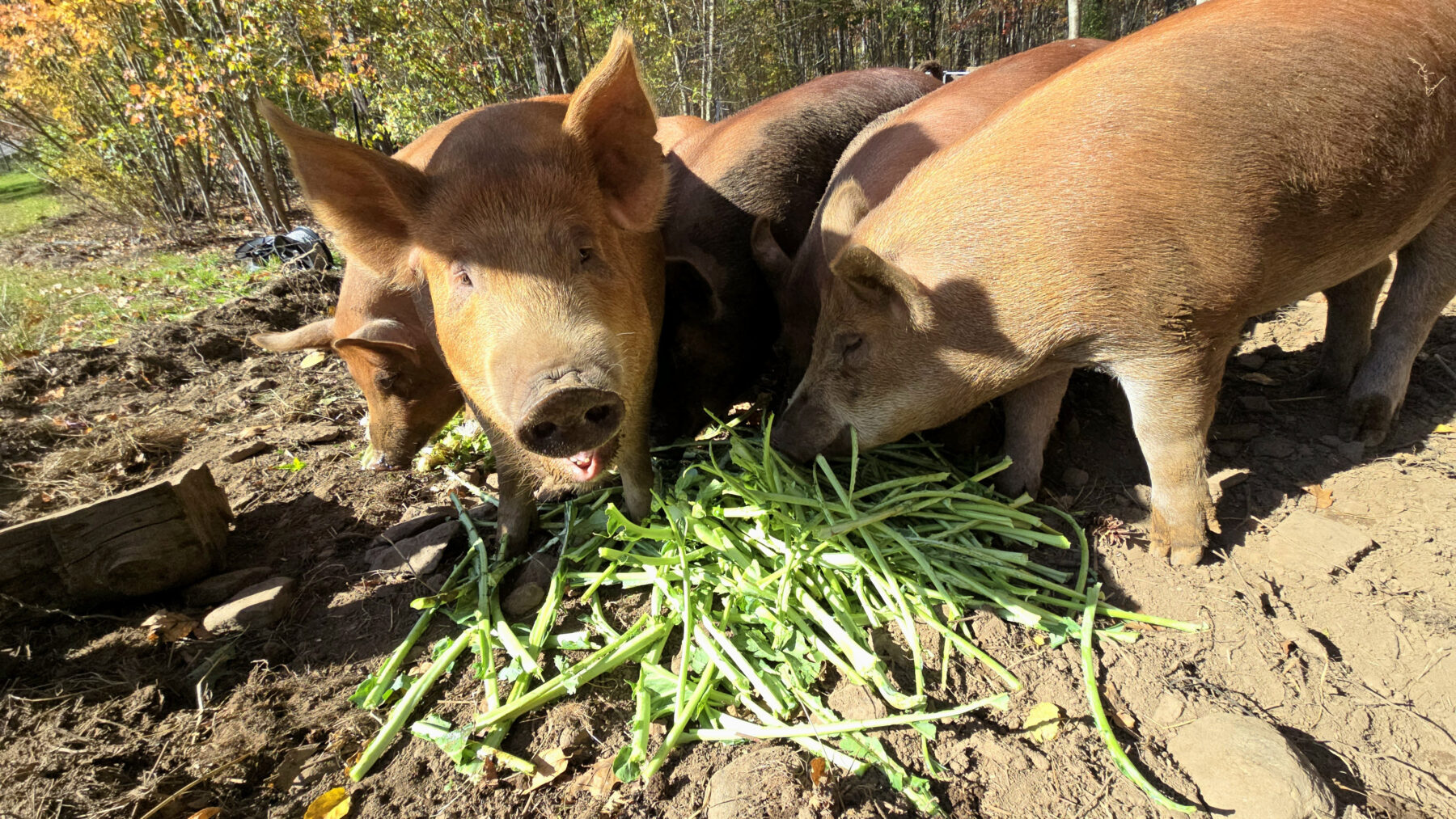
The pigs liked the collard and kale stalks

We have old layers for sale
$20 each, fresh (in the bag) on Sunday, October 26, 20 birds available – great soup! Email me at julie@mhof.net to reserve.
We also have young layers for Sale
We are selling up to 10 young layers, Rhode Island Reds born July 23. They should start to lay sometime in January, and cost $25 each.
We are back selling eggs again
At $9/dozen – perhaps the world’s best tasting eggs, who eat certified organic feed and who have fresh pasture 5 days out of 7, from our super healthy and diverse pond field pasture/hayfield.
We are looking for a male non-neutered puppy, either a hound dog cross or a shepherd cross. Skippy and Harriet are looking for a future mate and we are looking for a young guy who likes to chase carnivore predators. Does anyone have any leads?
We are also looking for two kittens, also non-neutered, to bring these wonderful animals back into our family. If you know of any, please let us know.
Gratitude this week
Dave Petrovick is a friend, neighbor, fellow farmer, as well as our farm mechanic and philanthropist. We have talked over the years about MHOF donating food to the Barre Food Pantry, which is the brainchild of Dave. And he has run this low-input high-quality food pantry for 24 years. This past year we solicited donations from you all to support the Food Pantry. And we now have enough extra food to “cash out” your donations. Thursday, I delivered a bunch of produce and eggs to the Barre Congregational Church and was delighted to see real and high-quality food being dropped off for donation. Dave was the MC, and was operating in his characteristic self-effacing manner, welcoming a string of volunteers who were there to distribute the vegetables, eggs and meat that had been donated by farmers and others from our region. As I helped Dave move tables, I grilled him about their nice tables, refrigerators and chest freezers, all of which he offhandedly noted he had written grants for. He has a special name and/or comment for each volunteer, all of whom seemed highly invested in being there to participate in this simple and elegant way for neighbors to support neighbors. My quick evaluation of the workings of the Barre Food Pantry left me grateful for people like Dave who can organize and actualize a community service that leaves all who are involved in it feeling like a useful part of a greater good. I have always felt very fortunate that Dave is our mechanic, and it was delightful to see him in this other so successful manifestation of his talents.
2025 MHOF CSA

Share from October 17
Week of October 20 – this is the second to last week of the summer CSA
This week you can expect the following :
CSA
- Lettuce
- Asian
- Cilantro
- Arugula
- Kale
- Celeriac
- Carrots
- Beets
- Tomatoes
Sign up for the fall share now
Keep the good food times going!
A fall pickup location has been added in Brookfield at Tip Top CoOp on Wednesdays.
Add that to pick-up locations at the farm, in Gardner, Athol, Shrewsbury, Worcester and Holden. We presently have 58 shares for the fall and can make room for 10 or 15 more.

Watch on Instagram
Watch on Facebook
Neurodiversity
by Jack Kittredge
Science Magazine published an editorial last year entitled “Science needs neurodiversity”. In it Holden Thorpe, American chemist, professor, chancellor of the University of North Carolina at age 43 and now editor-in-chief of the Science family of journals, who is himself autistic, makes the plea for us to accept the fact that all human brains work differently, cognition is complex, and we can do a far better job of appreciating the catalytic potential of neurodiversity, particularly in science.
In a thoughtful 3 paragraphs Thorpe brought me into his moving personal story. Called “hard to read” and “wooden” as a child, he attributed his monotone communication style to being an introvert. As he assumed roles requiring him to lead an institution and constantly interact with people, however, he struggled and needed training for skills most of us master early: eye contact, hand motions, vocal modulations of tone. He was of course fortunate to have fewer debilitating symptoms than many on the autism spectrum, and to have the financial and personal resources to get help.
But just as height, vocal pitch and disposition seem distributed among newborns along a bell curve providing lots of ‘typical’ and a few ‘outlier’ babies, as Robert Rubin of UCLA puts it: “…each of us is neurodiverse – in intellect; social skills; artistic, mathematical, musical, and reasoning ability; introversion/extroversion, and a plethora of personality types, all of which have ‘neuro’ origins.”
Given all else that we see around us it seems foolish to dispute that neurodiversity is also distributed naturally along a spectrum. We may be seeing more outlier examples now than previously, and research can perhaps help us understand why. But we are having to face two realities at least.
First, some people are needlessly suffering because many of us do not recognize this as a natural diversity and mistake certain behaviors as intentionally offensive when they are not. Thorpe suggests that to the extent we can destigmatize neurodiversity and encourage understanding of it, we can reap benefits not only for these people but from some of the noted abilities of autistic thinkers to connect ordinarily disparate concepts and reveal hidden truths.
Second, like all else we will have to face given our growing understanding of genetics, couples will more and more want to “design” their babies to produce super athletes, brilliant thinkers, children blessed with exceptional health, beauty and talent. Who would not do that for our children if we could? But just as sacrificing diversity to breed a crop of exceptionally large pumpkins or sweet corn can expose you to natural disaster from pest or plague, accentuating certain obviously desirable traits among our offspring may well leave us bereft of the crucial ‘outliers’ which provide depth and stability when needed.
A good recipe from Bunny, an egg customer, that I thought worth sharing
Turmeric base organic immune system drink
1/2 cup turmeric powder
1/2 ginger powder
1/4 cinnamon powder.
Cinnamon stick
Ginger root
Turmeric root
Simmer the above for 20 minutes with enough water to cover…… Enough to keep it from burning, but you want it to become quite thick.
Once cool, store in glass container in fridge
Mornings or anytime for a healthy cup of healing tea: to a cup of 190° water add the following — lemon juice, cayenne pepper, black pepper, coconut oil, honey to taste.
Make this as spicy as you wish
Abe Collins – Soil and Nutrition Conference
Each of the 6 weeks so far of the Soil and Nutrition Conference have been excellent either in food for thought or in practical applications for farmers, and I felt this past week was the best so far. I have known Abe Collins for years as a “carbon head”. He has moved into a new lane with his work helping farmers in VT and more recently all over the world build top soil at amazing rates with the use of keyline rippers, microbiology and minerals. If you are a grazer, particularly, find his stuff!
Landstream – https://www.landstreamdesign.com/
LandCare Cooperative – https://www.landcarecoop.com/
LandWEB – https://www.landweb.org/
It’s not to late to sign up for the last 6, and you will get access to all of the talks – https://www.bionutrient.org/snc/
Jennifer’s Recipe
HI Julie,
Here is my recipe for the week. Of course it is made from your chickens and many of the vegetables. It has fennel again this week but celery could be a nice replacement if needed.
Enjoy!
Jennifer
Hingvastak Chicken & Garden Root Soup with Fennel, Rutabaga, and Cabbage
This soup embodies what it means to eat seasonally and intentionally — grounding roots, warming spices, and digestive herbs all coming together in a gently spiced, aromatic broth. The base — made with Hingvastak churna, an Ayurvedic blend of eight digestive spices — stimulates agni and clears ama (toxins), while apple adds a subtle sweetness and cleansing quality that harmonizes the flavors.
Chicken provides strength and nourishment for the tissues (especially mamsa dhatu), while rutabaga and carrots root the body in stability and warmth. Fennel soothes digestion and balances the subtle tension in the nervous system, and cabbage supports gentle detoxification and colon health. A final touch of lemon juice brightens the entire bowl, awakening the senses and enhancing nutrient absorption.
From a Western perspective, this soup is rich in vitamins A and C, minerals, fiber, and natural antioxidants — a restorative blend of gut-healing and immune-supportive ingredients. It’s a perfect example of how Ayurvedic wisdom and modern nutrition meet in the kitchen: wholesome, flavorful, and balancing for body and mind.
Enjoy it with a slice of sesame sourdough brushed with ghee and, if possible, outside in the crisp autumn air — nature’s dining room always adds a little extra prana.
Farm Doins
Two weeks ago, we had a visit from some Clark students doing a study of our soil organic matter and carbon management.

Speaking of students, the drone crew from WPI came three times this week, Nigel and Vicki came to do a farm volunteer day, also from WPI, and Julia stopped in from UMass to interview us about practices. By the end of the morning, she was splitting garlic for planting with the best of us.


We love student visits, either official with a prof, or individually. Be in touch.
This week we spent the better parts of M, W, F mornings on the CSA, after the frost left the field, weeded all the spinach

Covered many more beds with Reemay, moved our four big boxes into the greenhouse and planted them with lettuce seedlings, took our research squashes from the point of digging out all of the seeds (dark star, yellow crookneck and costata romanesca), putting them on to ferment, drying and finally collecting them for their final weights. Many thanks to Leslie who managed this project that we collaborated on with the Organic Seed Alliance. If you would like any of the seeds to plant next year, stop by and get a pack!


Jim, Brandon and Justin processed all but one monster log from the Town’s cutting spree on Sheldon Road, and took apart our old dilapidated hay cart, which we took apart piece by piece and delivered to the dump.

Julie

I had to grab this picture of Danny, always the last to the table on Mondays, demonstrating the proper protocol that those first to the table should sit in the center seat that is impossible to access after the sides are already taken.