July 21, 2025
Dealing with the Heat
Everyone has a different relationship to the heat of these sometimes-intense July days. On Wednesday, I sent folks home early, right after lunch, because none of us could bear the thought of working those hours between 12:30 and 3. We did have an interesting experience in the hoop house around 9:30 when we dashed in to harvest the spearmint for the CSA. Who knows how hot it was in there, but as we cut the mint, the volatile oils along with the sauna effect had an interesting impact on all of us, cleansing and purifying our pores, and then upon exit, a momentary cooling!
My favorite in field cooling strategy is to spray my head and my back with the hose (after running out the boiling water from the sun-heated black hose), then filling my hat and dumping it on my head. And preparing for the heat, I am convinced, is best done by consuming fats and proteins. We have our 10 am peanut butter ball snack strategically, preceded by a big breakfast of whole oats, buckwheat, chia and sunflower seed, and flax oatmeal and scrambled bacon, eggs, and vegetables.
And of course, misery loves company. A week ago Friday we had a raucous end of the day in the celery patch complete with weed throwing and spicy language in English, Spanish and ASL. I continue to bless my lucky stars that we have such a stalwart crew.
The good news is, I hope, that it is always hottest at about 1 month after the Solstice, and we will hope that as we enter August at least the nights should cool down.
Gratitude this week
It goes to Amanda this week. Friday, she brought me some gut healing gummies that she made for me. Many people have assisted and cared for me over the past 3 weeks as I slowly pull out of the Lyme cloud. This extra support and care from Amanda this week was especially poignant. Here is a link to the recipe for those gummies should you get bit by one of those little darlins!
Get the Recipe at Milk and Honey Herbs
More on Weeds and What They Tell Us
compiled by Jack Kittredge
Our previous short description of three weeds, their strengths, frailties and what they tell us about our soil was enjoyed by a few readers so here is another listing of weeds – four this time.
Dandelion (Taraxacum officinale ) is a short-lived perennial that will grow just about anywhere, regardless of soil conditions, but rich soil will improve its growth. They withstand frost and freezes and tolerate crowding. Heat and insufficient moisture will cause the leaves to get bitter, but it won’t kill the plant, each of which can produce up to 20,000 viable seeds and can grow new plants from its roots or from seeds. They have a strong taproot that commonly penetrates at least 6 to 18 inches, if not deeper, into the soil. Dandelions are quite adaptable but thrive in well-drained, slightly acidic to neutral soil with good moisture. They particularly benefit from soils low in calcium or with poor organic matter decay, and thrive in soils rich in nitrogen and potassium. They do not grow in soil high in phosphorus. While they can tolerate poor soil, enriching the soil with compost or a planting mix can improve their growth and overall health, especially if you plan to harvest them for consumption.
Galinsoga (Galinsoga paviflora) A rather unassuming weedy plant, galinsoga often comes and goes in the garden without really being noticed at first. Easy to pull due to its shallow root system, the plant doesn’t have big flowers or nasty prickles or spreading rhizomes or tangling tendencies. Ask a farmer about galinsoga, though, and you’ll get an earful about what a nuisance it can be. Galinsoga comes up in early summer and, if left unpulled, it has the ability to produce multiple generations until the first frost. It’s tempting to add the plants to your compost pile as you weed; its juicy, nitrogen-rich biomass breaks down easily and seems like a gift of greens. But alas, if you do, you’ll see the effects of one of galinsoga’s most effective survival strategies. Those tiny flower clusters—five 3-toothed white petals around a yellow center—produce a plethora of seeds that mature almost immediately. So the common weed management strategy of pulling before the flowers fade and the seeds have set doesn’t work here. As soon as the plant has flowered, it’s already on its way to producing the next round of baby galinsogas. It prefers fertile, moist and slightly acidic soils on streamsides and sparse forests. It is a widely distributed crop weed in China and is a fast growing plant very common in humid areas and in old vegetable cultivations.
Lamb’s Quarters (Chenopodium album) is a cool season plant that can produce tens of thousands of seeds, the secret to its success as a weed. If we don’t pull or plow under the seedlings before they’ve flowered, we’re left to battle with multiple generations in one season. In the Punjab region of India and Pakistan, people intentionally grow lambs quarters as an agricultural crop. The leaves are exceptionally high in vitamins A and C, as well as in calcium, iron, and protein. The plant also provides a number of ecological services. Its long taproot extends deep into the soil, drawing water and nutrients closer to the surface and allowing more shallow-rooted plants access as well. Lamb’s quarters, also known as wild spinach, likes soils with a pH from 4.5 to 8.3. It can tolerate compacted and poor soils, making it a versatile plant. Full sun is ideal, but it can also tolerate partial shade. It prefers moist, well-drained soils with low levels of phosphorus, but high levels of soil nitrate and potassium. It also likes high levels of calcium and magnesium, and grows well on compacted soils.
Pigweed (Amaranthus spp.) There are 3 primary varieties: Powell, redroot and smooth. Germination and emergence occur over weeks, with an aggressive spurt of growth in May through June. Flowers are present from July to September. Seeds are formed from August to October. One plant can produce an average of 13,000 to 35,000 seeds. Pigweeds have evolved multiple processes that allow seeds produced in a given season to germinate at different times over the next several years. This allows pigweed to survive in the soil seed bank, taking three years to reduce the seeds in the soil to 50 percent. Growing in full sun pigweeds tolerate a variety of soils, growing in clay, loam, or sand. These weeds prefer rich soils, high in organic matter and in Nitrogen, Phosphorus, and Potassium. Their presence is a sign that the soil’s iron-manganese ratio is out of balance. They grow well on compacted soils but growth is reduced on low pH soils and by low light.
Some inspiring words that I want to share
https://www.themahapac.com/post/reflections-on-the-maha-movement At this very busy time of year, I have almost entirely sworn off of reading anything non-essential, but lately have tuned into the MAHA report. Teddy Macker reminds me of Wendell Berry, who he quotes here. Enjoy this non-partisan, holistic offering for us to consider.
My Reading Adventures
I have a bunch of health-related books stacked up in my brain (all listened to on Audible in my spare moments), and all pretty excellent. Good Energy by Casey Means, the now new Surgeon General, Gut Check by Stephen Gundry, and I am also on my third book by Mark Hyman, The Five Forces of Wellness written in 2014, Food: What the Heck Should I Eat, written in 2018, and Young Forever: The Secrets to Living Your Longest, Healthiest Life, written in 2023. It is interesting to follow his growth as a nutrition-based doctor through these years of intense research and gaining of knowledge around the gut biome.
I would highly recommend all of these books for those who want to evolve your health to its highest potential. One of my biggest takeaways was that according to all three of these authors, grains are not that good of a thing, it being introduced into the human diet recently, evolutionarily speaking, and beans, perhaps aren’t as good a choice, particularly for heavy consumption, as many health advocates have suggested.
2025 MHOF CSA
I am always enthusiastic about the summer squash when it arrives on the scene, and also the cucumbers, which both came in profusely this week.

Watch on Facebook
Watch on Instagram
Dingo has been guarding our Swiss chard from the deer at night (though he slipped off his collar on Friday night). More choices for crops are with us now. Sadly, our first crop of green beans fell prey to bugs, but the second crop is looking good.
Coming this week
- Summer squash and zucchini
- Cucumbers
- Basil
- Lettuce
- Chard
- Kale or collards
- One last week of cilantro
- Beets are back
- Some green beans
- Arugula still is holding regardless of the heat
- An Asian Green for each of you
We are hoping for some rain, but it looks iffy.
Jennifer’s Recipe for the week
Breakfast Beet Bowl with Avocado & Soft-Boiled Egg
This deeply nourishing breakfast bowl brings together the grounding, blood-strengthening power of beets with the gentle digestive magic of fennel. Sautéed with onion and garlic in ghee, the beets become sweet, tender, and easy to digest—supporting both Vata and Pitta balance. Fennel, known in both Ayurvedic and Western traditions for its carminative and anti-inflammatory properties, adds a light, balancing finish to the dish. The soft-boiled egg contributes stability, protein, and vital nutrients like iron and choline, while creamy avocado offers healthy fats that soothe and hydrate the tissues. Finished with a squeeze of lime for brightness and a splash of balsamic to bring it all together, this bowl supports digestion, energy, mood, and resilience—an ideal way to begin the day with clarity and calm.

Get the recipe at Jen Zen Living
27th Annual North Quabbin Garlic and Arts Festival
Sept 27/28, 2025, Orange MA
The “Festival that Stinks” is a fabulous family-friendly destination held amid the fall foliage on a historic farm in Orange, MA. Wander among over 100 exhibitors with amazing art, farm-fresh products and food, healing arts, and community organizations. Three stages delight with music, performance, and spoken word. Travel the globe with glorious garlic cuisine and chef demos. Enjoy the free kids’ art-making tent and garlic games for all ages. Orange is the new green! Skill up with local living workshops, EVs on display, and only 2 bags of trash for 8,000 people.
Inflation busting general admission is only $10 for the weekend; $5 for students, seniors, and Card to Culture: (EBT, WIC, and ConnectorCare cardholders), kids 12 and under are free. Save time, buy tickets online starting Sept 1. Visit www.garlicandarts.org for the full array of exhibitors, performances and workshops, and parking and shuttle info. No pets, service animals only. The festival is actively seeking volunteers for the event weekend—learn more and sign up to volunteer for a shift- there are many tasks from which to choose.
The North Quabbin Garlic and Arts Festival is organized by an all-volunteer committee of friends and neighbors. The non-profit fiscal sponsor is Common Good. Follow the festival on facebook: @North Quabbin Garlic and Arts Festival and Instagram @nqgarlicandartsfestival for regular updates on all of the great exhibitors, performers, and happenings!
Farm Doins
Despite the rough weather, we have been accomplishing much on the farm. This is the time of year that I attempt to pick for CSA, weed necessary crops, and transplant new ones, all somehow at the same time. We carry our hoes with us whenever we pick, and either weed the crop we are picking or an adjacent neighbor. Monday is always our mowing day too. We got the place gussied up for a minute, and Jim was able to cut a bunch of brush that was growing in front of our solar panels. We squeezed in 6 gallons of berries also. Tuesday found us making a big bird move. They are all now in a 9-cage row on the south end of the farm.

Watch on Facebook
Watch on Instagram

And then we harvested our garlic, with about 75% of it being of high quality and the other 25% good only for garlic powder. The wet spring took a bit of a toll on the garlic patch, but it could have been worse.

In the afternoon on Tuesday, we cleaned up large portions of the garden, leaving just a small patch of un-weeded sweet potatoes. Wednesday was focused on getting the CSA done without frying us or the food, and included making our first batch of summer squash puree for the freezer for next year’s ubiquitous soups. On Friday we were able to get more lettuce in. With promised rain on Thursday that never materialized, we took the plunge anyway, and hope that the lettuce will make it.

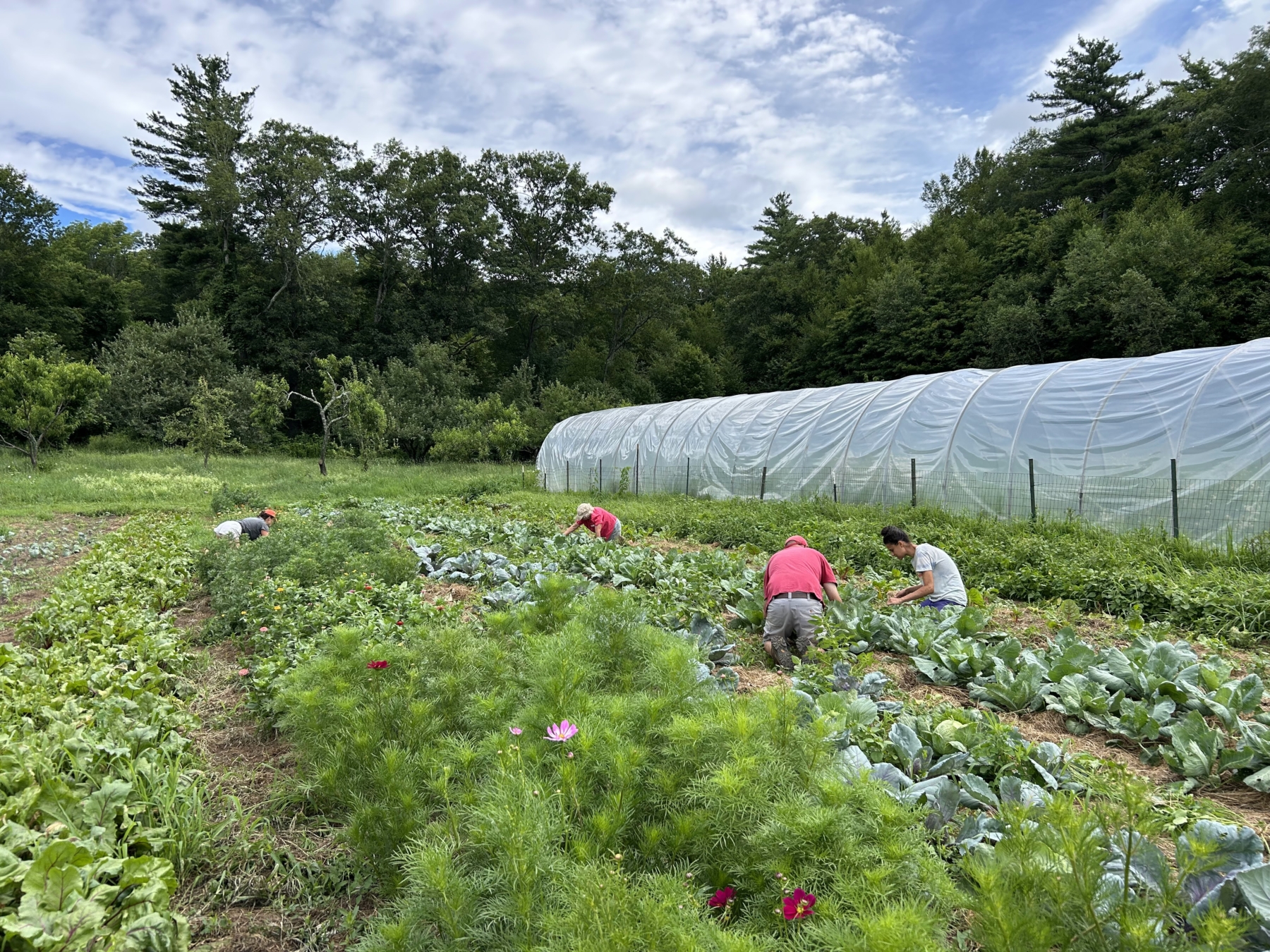
Weeding cabbage and flowers on the way by

Transplanting in lettuce
Despite no good promise of rain, we hope to do some transplanting this upcoming week.
Lyme Report
Three weeks in on the doxycycline, I have decided to end the treatment. My “gut buddies”, as Stephen Gundry calls them, are lying all over the battlefield gasping for breath, and I am taking the leap to now try to get my internal system back into working order with herbs, nutrients, red light therapy, strength training and vitamins. The hardest part of the drug use was the clear disturbance in my gut that has left me wanting to quit farming and seeing almost everything I do as a chore. I will let you know how it goes.
Julie

Clare house looking mighty fine – our secret cucumber spot
Quick Links
Buy Meat
2025 CSA Order Form
Contact Julie
Products Available Now at the Farm
Become a working shareholder
Donate to the MHSC
Workshops
Buy J and J’s book
Many Hands Make a Farm
https://www.chelseagreen.com/product/many-hands-make-a-farm/
Leave a Reply
You must be logged in to post a comment.